



of every work week is lost hunting for information
 Cottrill Research
Knowledge management for organizations: keeping the judgement, not just the files.
 home
home
This one found me before I went looking. Day one of my Info Edge internship (the same summer as case 03): a laptop, a Slack account, and a polite avalanche.
The PRD was in Confluence. Decisions in Slack. Tickets in Jira. Numbers in Sheets. The context was in someone's head, and that someone was in meetings until Thursday. A year later, Aarya and I compared internship notes and found the same wound in both.
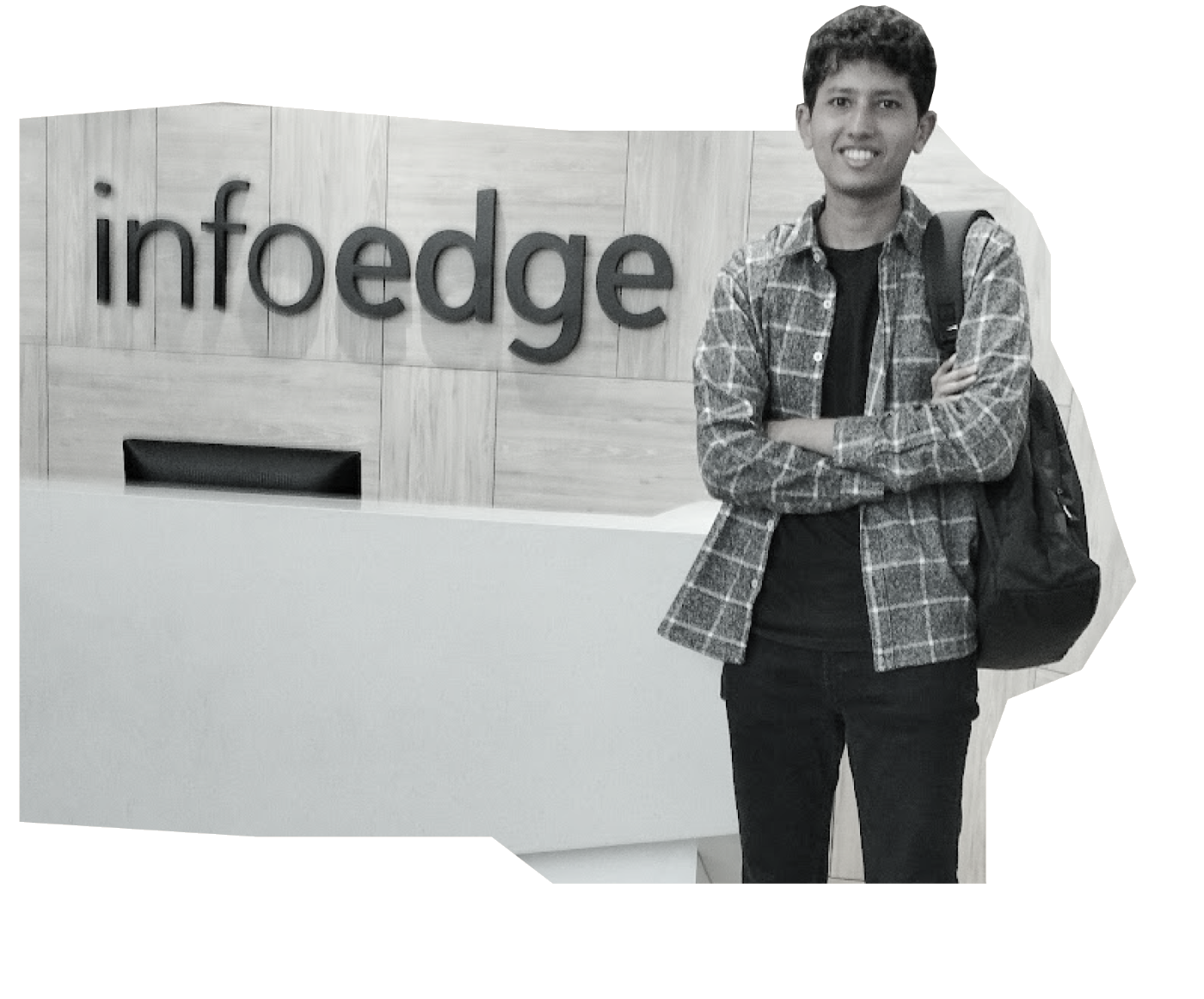 day 01 · fresh & clueless
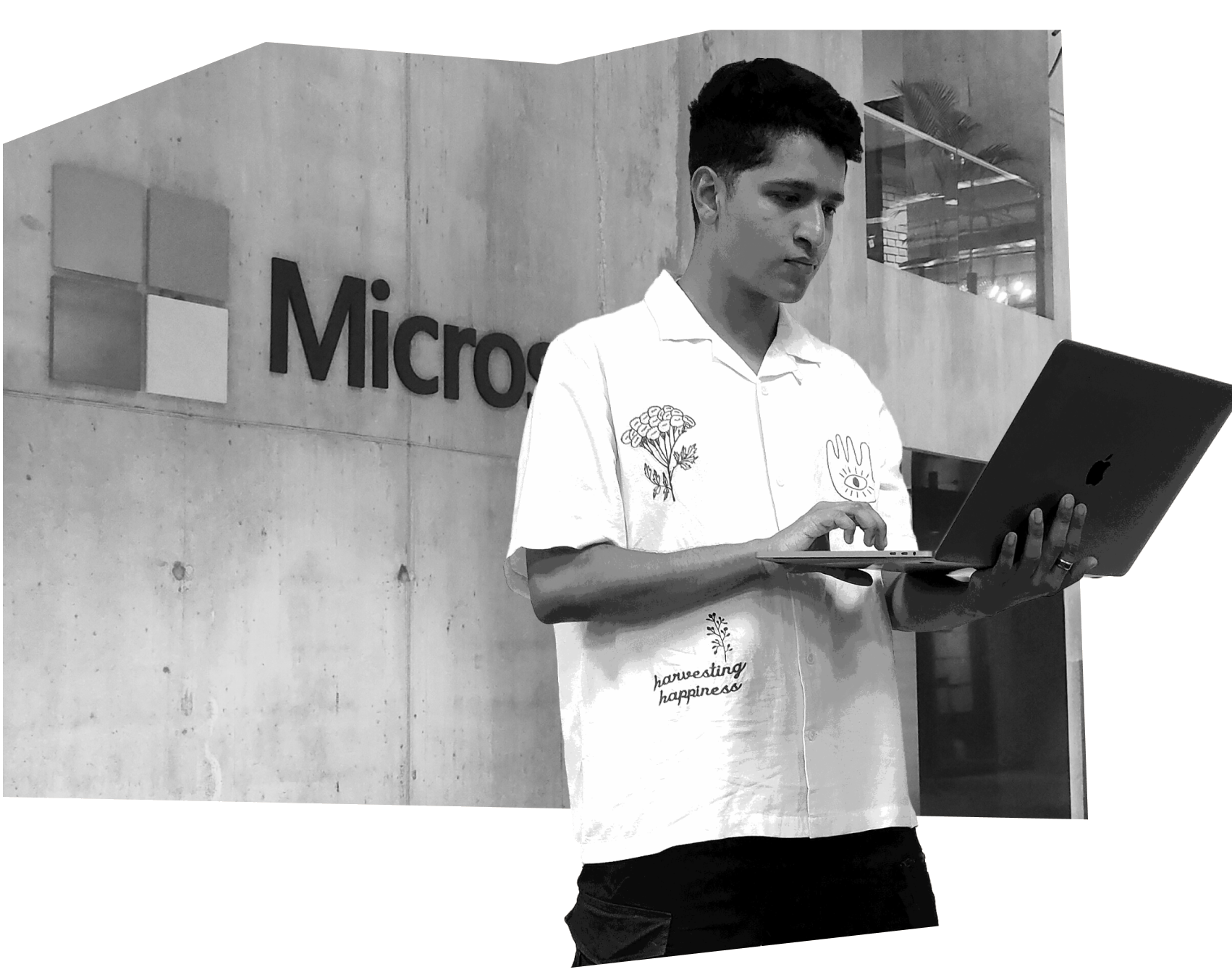 aarya · same summer




“where's the latest PRD?”
“check notion. or the deck. maybe both.”
“found three versions. which one is real?”
“just hop on a call, it's faster if I explain.”
Every answer exists somewhere. Nobody knows where, and the person who does is the bottleneck.
skipped on mobileA pinned scene of six tools and four overheard quotes colliding as you scroll, it needs the room to feel like chaos. The short version: every answer exists somewhere, nobody knows where, and the person who does is the bottleneck.
And this isn't an intern problem. It's an industry-sized tax that shows up in every study we could find:
of every work week is lost hunting for information
Cottrill Research
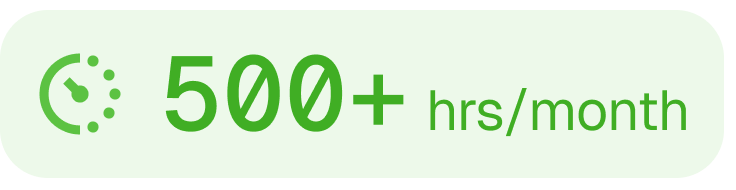
won back by Duolingo by fixing internal search
Work AIOnly 0% of employees say onboarding actually works.
 Gallup
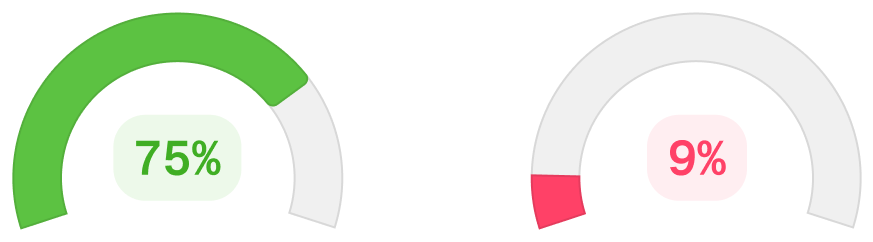
When experts leave, decades of tacit insight walk out too
BusinesswireCompanies don't lose files. They lose judgement: the why, the almost, the “we tried that in 2022”.
Structured. Easy to document. Easy to share.
Policies, manuals, tutorials, databases, memos
Applied through practice and context.
Learnings from shadowing, repeated tasks, internalized logic
Intuitive. Experience-driven. Hard to codify.
Judgement, culture, team memory, mental models, unspoken know-how
And tacit is the toughest to capture, the layer no document, wiki or handover call ever reaches.
The most valuable knowledge in a company has never been written down. Every tool waits for someone to write it down.
We anchored the thesis in Indian knowledge companies, not for convenience, but because the wound is deepest here:
And a SaaS market racing to $50B. Every one of those companies is compounding the same forgetting.
Every exit drains hard-won know-how. At Indian churn rates, memory loss is a quarterly event.
Yet 54% of leaders have no knowledge-management plan. Appetite without infrastructure.
Insecurity breeds knowledge hoarding, sharing what you know can feel like training your replacement.
The gap isn't retrieval, it's capture. The knowledge that runs a company never gets written down, and nobody is rewarded for sharing it.
Give organizations a memory that compounds: capture what teams learn, keep it alive, and serve it back in the flow of work.
A brief isn't an answer. Desk research could name the problem, not why people stay quiet. So we stopped reading and went to ask.
How are companies solving this today?
They are, and that was worth knowing, a whole category already exists. The problem was validated before we drew a thing. What none of it closed was the gap we kept falling into.
We sat with the people who lose the context
Then checked it against what the field already knew
“Even if the docs are there, I don't know where to start.”
new joinee · product
“Honestly? I just ask the senior sitting next to me. It's faster.”
engineer · 8 months in
“Documentation is nobody's job. So it becomes everybody's regret.”
engineering manager
“When our analytics lead left, half the funnel context left with her.”
product manager
Writing things down is extra work with zero reward. Knowledge gets shared in meetings and DMs, the places no wiki ever sees.
The same wiki greets an intern and a CTO identically. Nobody gets knowledge shaped to their role, project or level of context.
New joiners learn by shadowing seniors. It works beautifully, and scales terribly, taxing the exact people with the least time.
The industry is racing to search documents. Almost nobody is capturing what never becomes one.
We scored the tools companies actually buy against our workflow maps. Strong products, all of them, all stopping at the same wall:
The reference for retrieval: permission-aware search across 100+ tools.
Searches what's been written, never what was said or decided.
Verification and staleness alerts keep answers trustworthy.
Runs on manual curation, and nobody has a reason to curate.
Excellent answers, if your team already lives in Notion.
Workspace-locked. Slack threads and meetings stay invisible.
The most ambitious capture attempt: auto-topics across the M365 graph.
Retired in 2025. Even Microsoft couldn't make passive extraction stick.
Better search wins a feature war. Whoever solves capture + motivation owns the category, because they own the supply of knowledge itself.
Everyone was fighting over retrieval, so we went after supply instead: get knowledge out of heads without asking anyone to write documentation, and make sharing feel like winning rather than training your replacement.
A system this broad dies the moment it becomes “a bunch of screens”. So we built it in a fixed order, and refused to draw a single screen until the first three steps held.
Every flow got walked in two pairs of shoes, two seats at the same company, at opposite ends of the knowledge pipe:
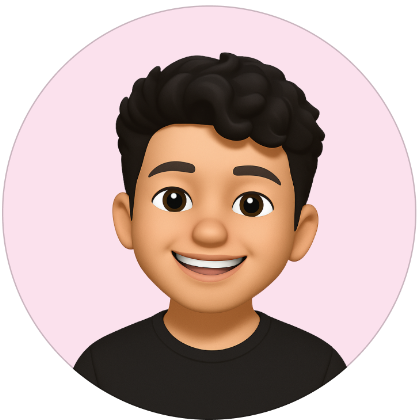
Week one, product analytics. Knows nothing about how this team works. Consumes knowledge; can't yet tell signal from noise.
knowledge sink
Five years in, carries half the team's context in his head. Everyone's favourite bottleneck. (Yes, we named him after me. Method acting.)
knowledge sourceWith those two on the wall, each finding hardened into a rule that outranked any screen:
Meetings, PRs, chats: knowledge gets caught where it's created, not where someone remembers to file it.
No “knowledge portal” anyone has to remember to visit. Taksha meets you where work already starts.
A new joinee and a senior never need the same answer. Context shapes everything served.
If contribution isn't visibly rewarded, the 47% who hoard will keep hoarding. Rationally.
Four rules, four pillars. Everything below the pillars is plumbing the user never sees; everything above it is a face on one of the four:
 Taksha
 17 connectors at thesis scope, read-only, permission-aware
 knowledge never leaves your walls
Every screen in chapter 04 is one of these pillars wearing a face. That was the test I kept applying: if a screen can't point to its pillar, it's decoration.
“The system diagram is the thesis. The screens are just proof it can exist.”
Our guide, Prof. Dr. Pratul C. Kalita, signed off on the direction at mid-review with one condition, every feature demo had to trace back to a pillar and a research finding. It became our editing knife.One more tab to forget, one more login to skip. Knowledge tools die of “I'll check it later”.
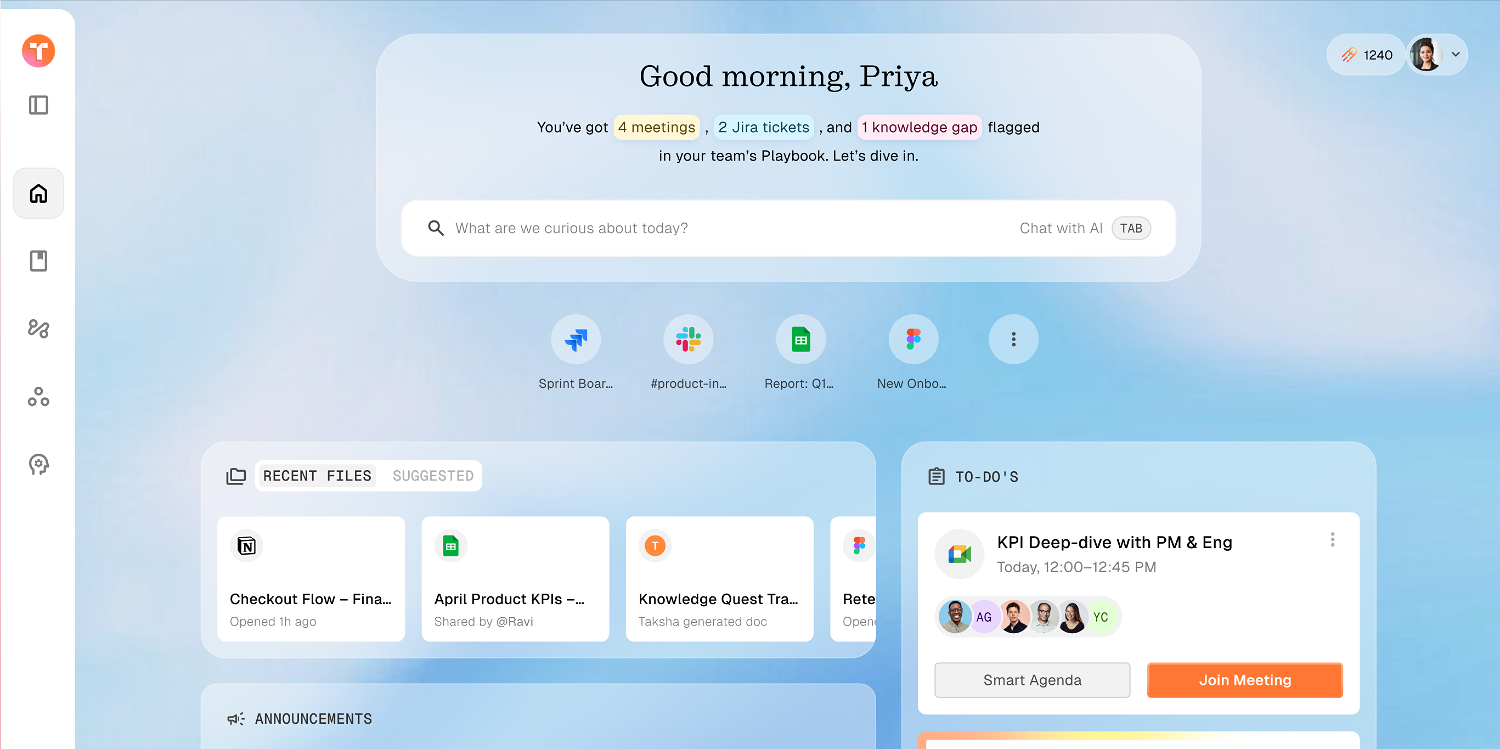
Taksha lives where work already begins: the browser's new tab. Zero habit change, every search, meeting and to-do passes through it anyway.
Takshashila (Taxila) is the oldest recorded university on the subcontinent: a place people travelled to because knowledge was kept, not hoarded. That was the ambition, so the name came from its root, takṣa: to shape raw material into something usable.
Which is the product's job. Raw material in, threads, tickets, half-decisions; something a new joinee can pick up out. Not a vault. A workshop.
Only then the drawing, and by then it was almost mechanical: workflow maps per persona → an object model (Playbooks, Story Cards, Sparks) → lo-fi → hi-fi. Weekly guide reviews and hallway tests on classmates who'd just come back from product internships kept each pass honest.
Named after Taxila, the ancient university where knowledge compounded for centuries. The demo runs as a story in two seats: Aditya's first week, then the senior's worst Tuesday.
A new tab that opens as a briefing.
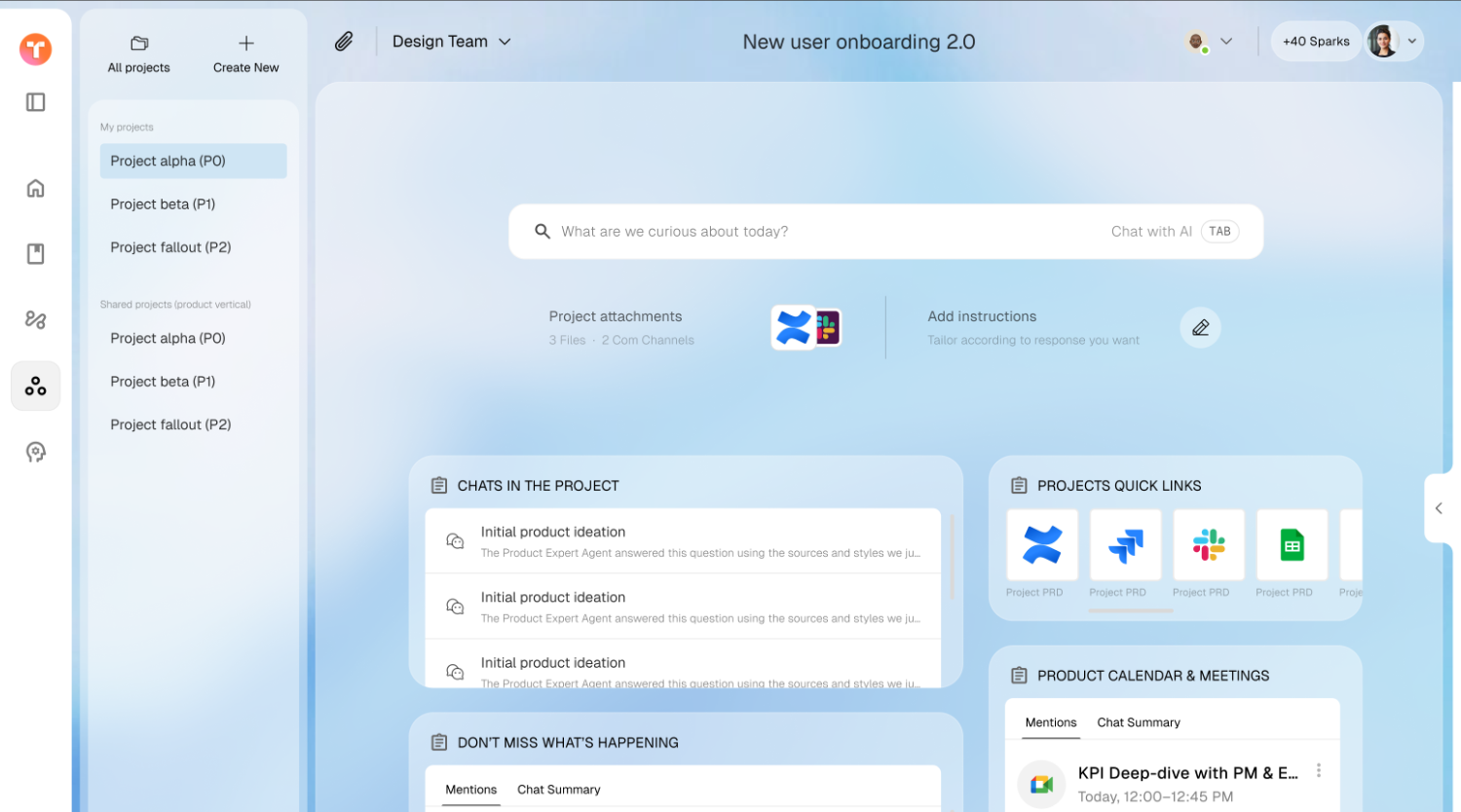
It opens like a briefing, not a portal: your meetings, your tickets, one flagged gap, one question, “what are we curious about today?”. Everything else hangs off that sentence.
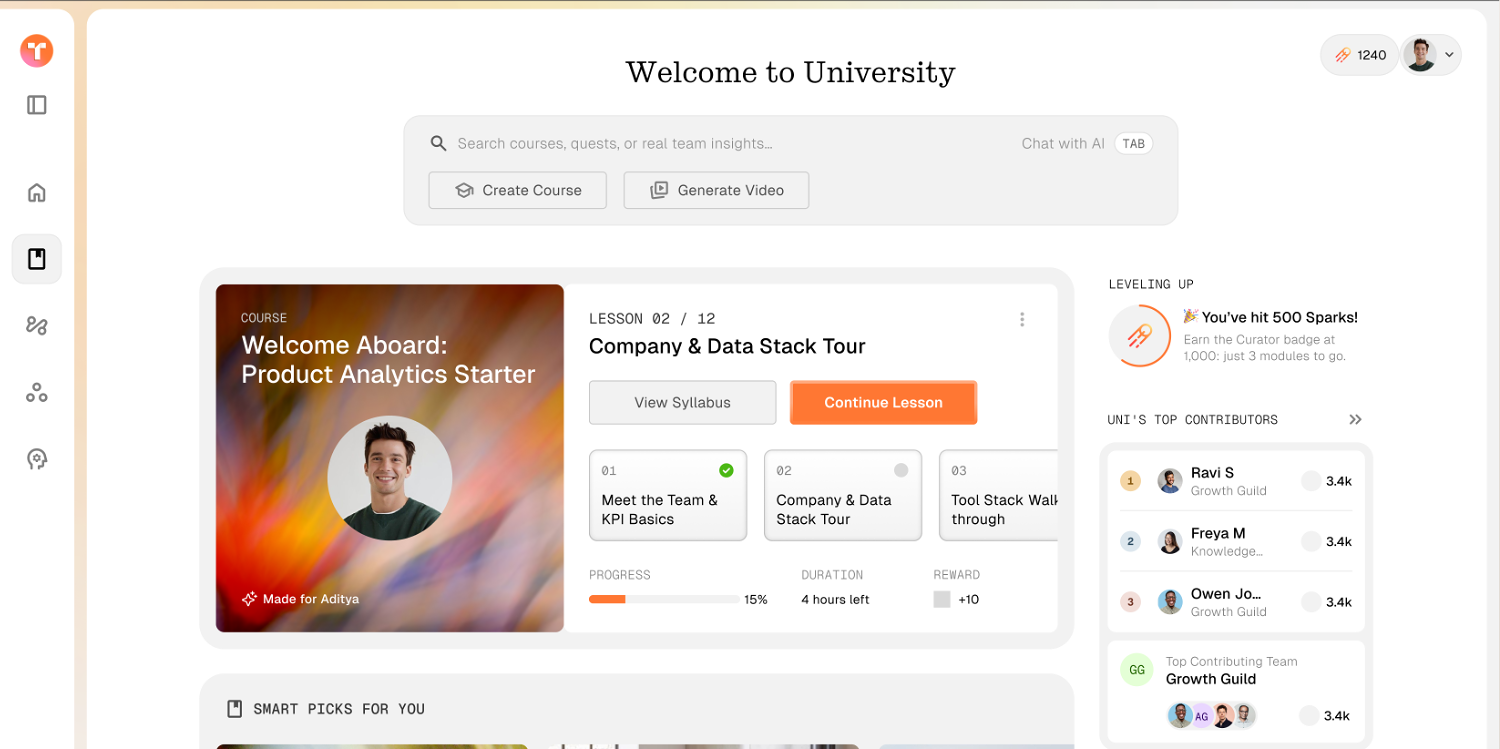
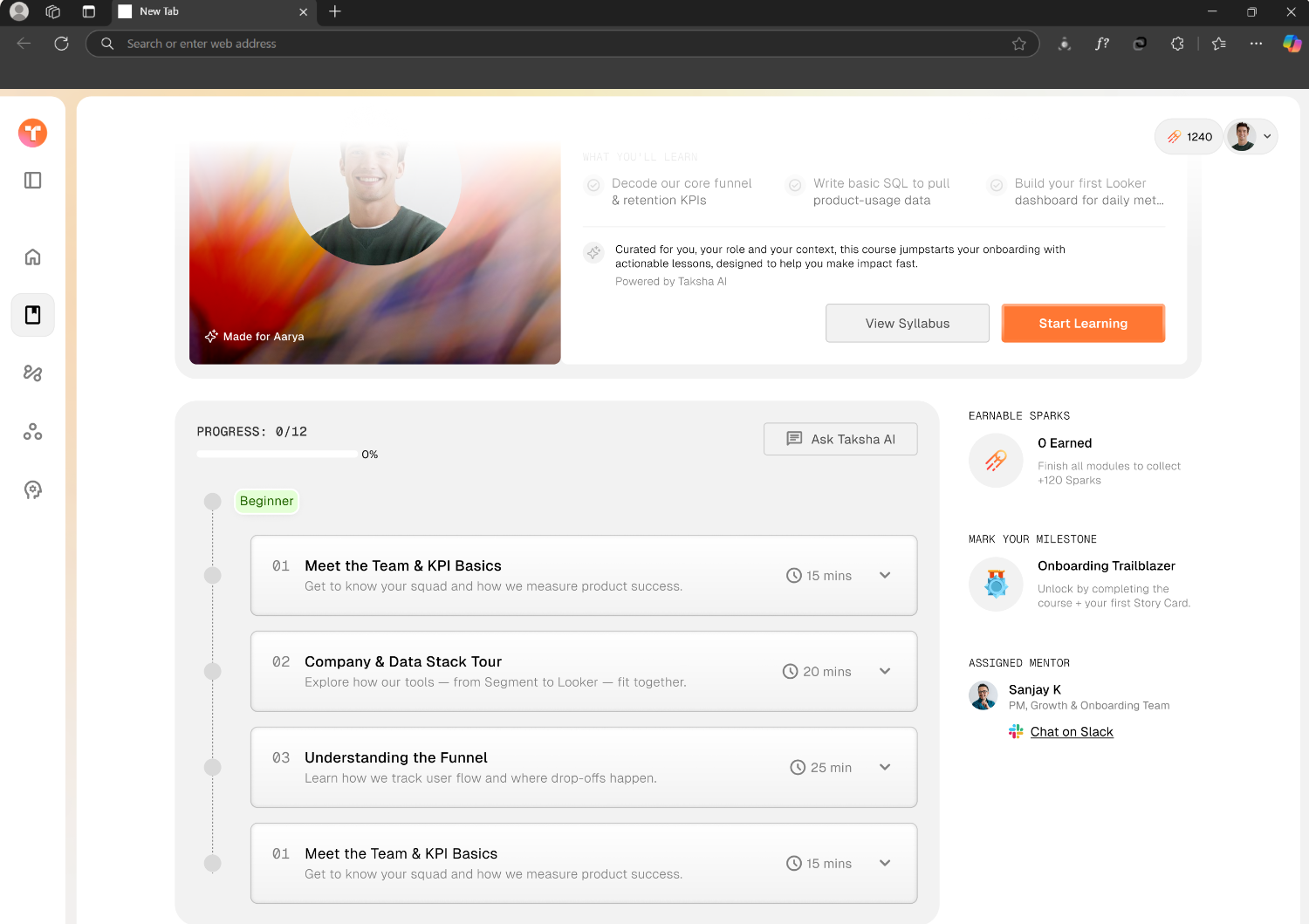
No orientation PDF. Taksha builds his first week for him. Four moments, in order:
His onboarding course, his meetings, his team's files, all assembled from role + project context before he asks for anything.
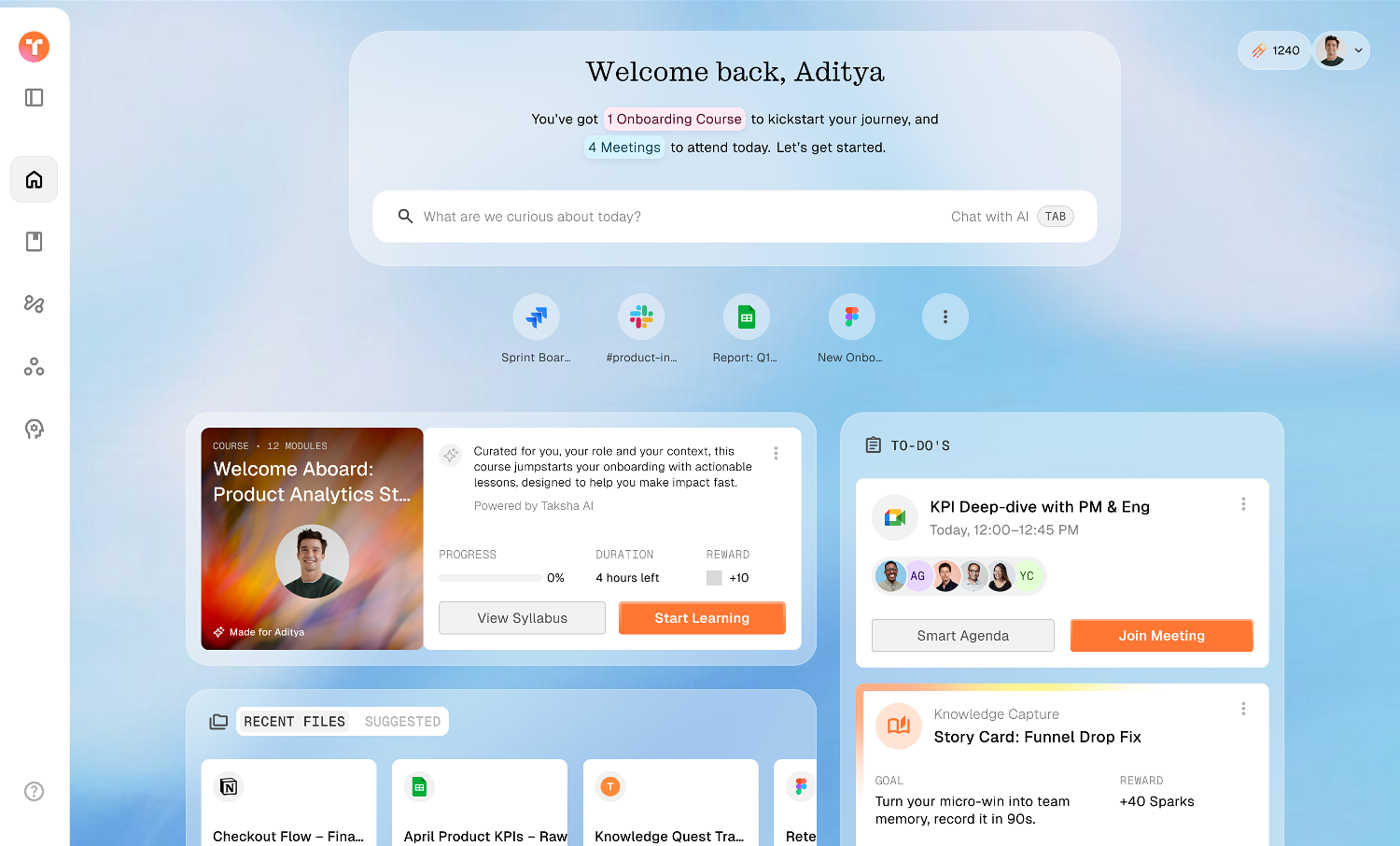
“Welcome Aboard: Product Analytics Starter”, generated for his exact role, then approved by a human lead.
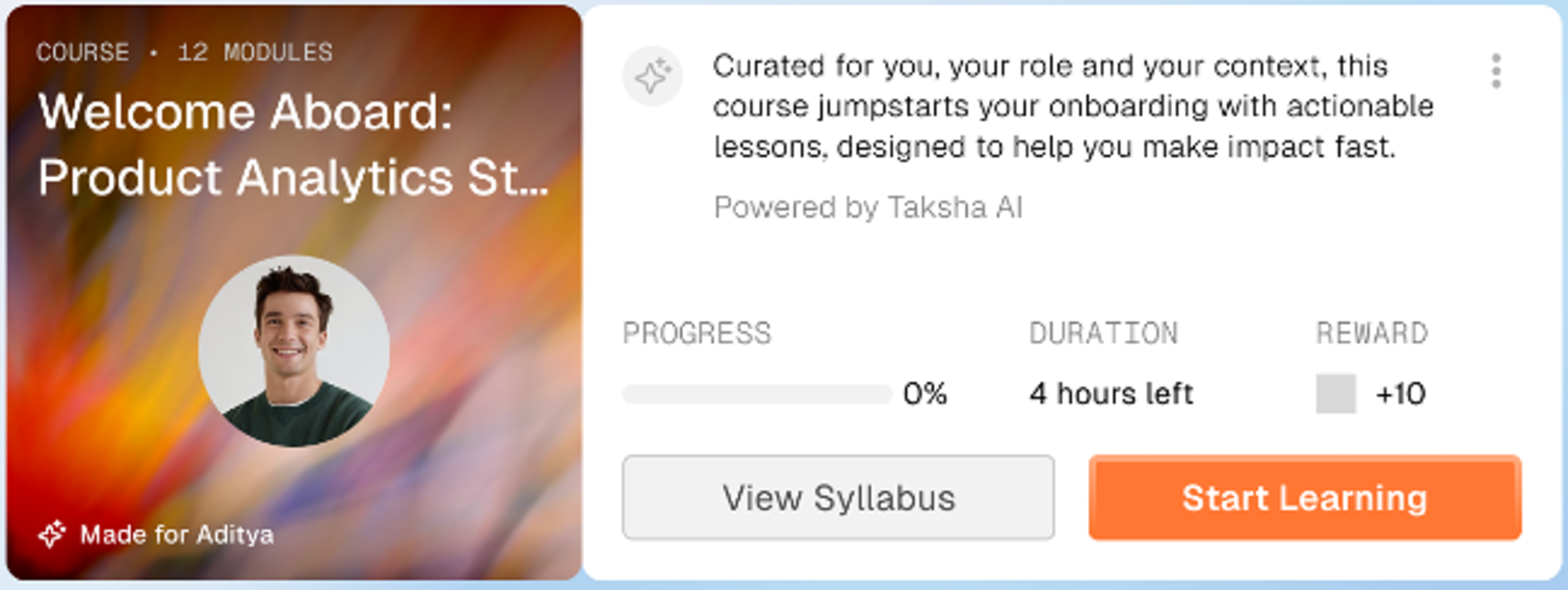
12 lessons, 4 self-paced hours, a mentor one Slack click away. Every lesson traceable to real team files.
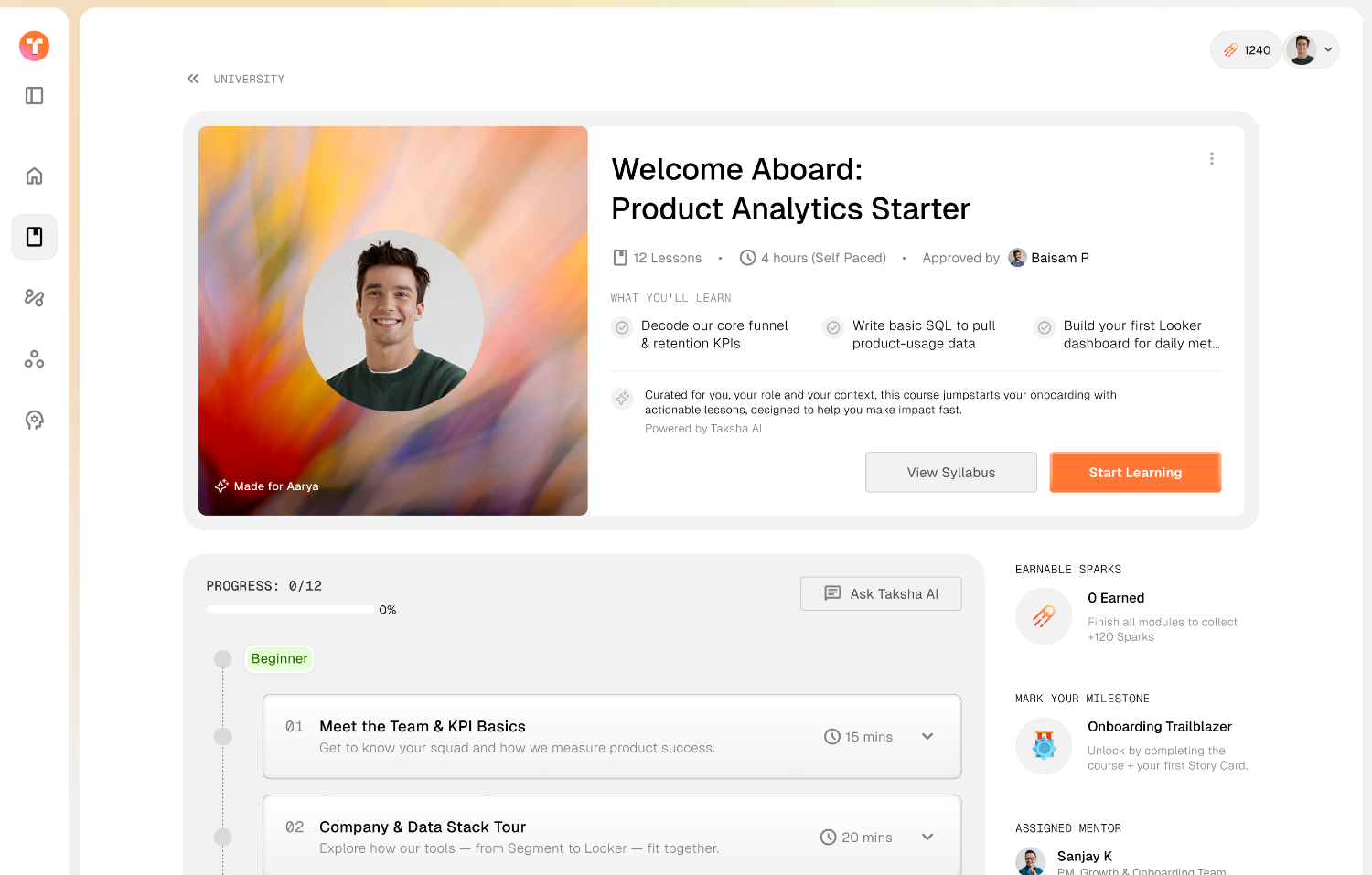
Sparks and badges land from the first module. Momentum is designed in, not hoped for.
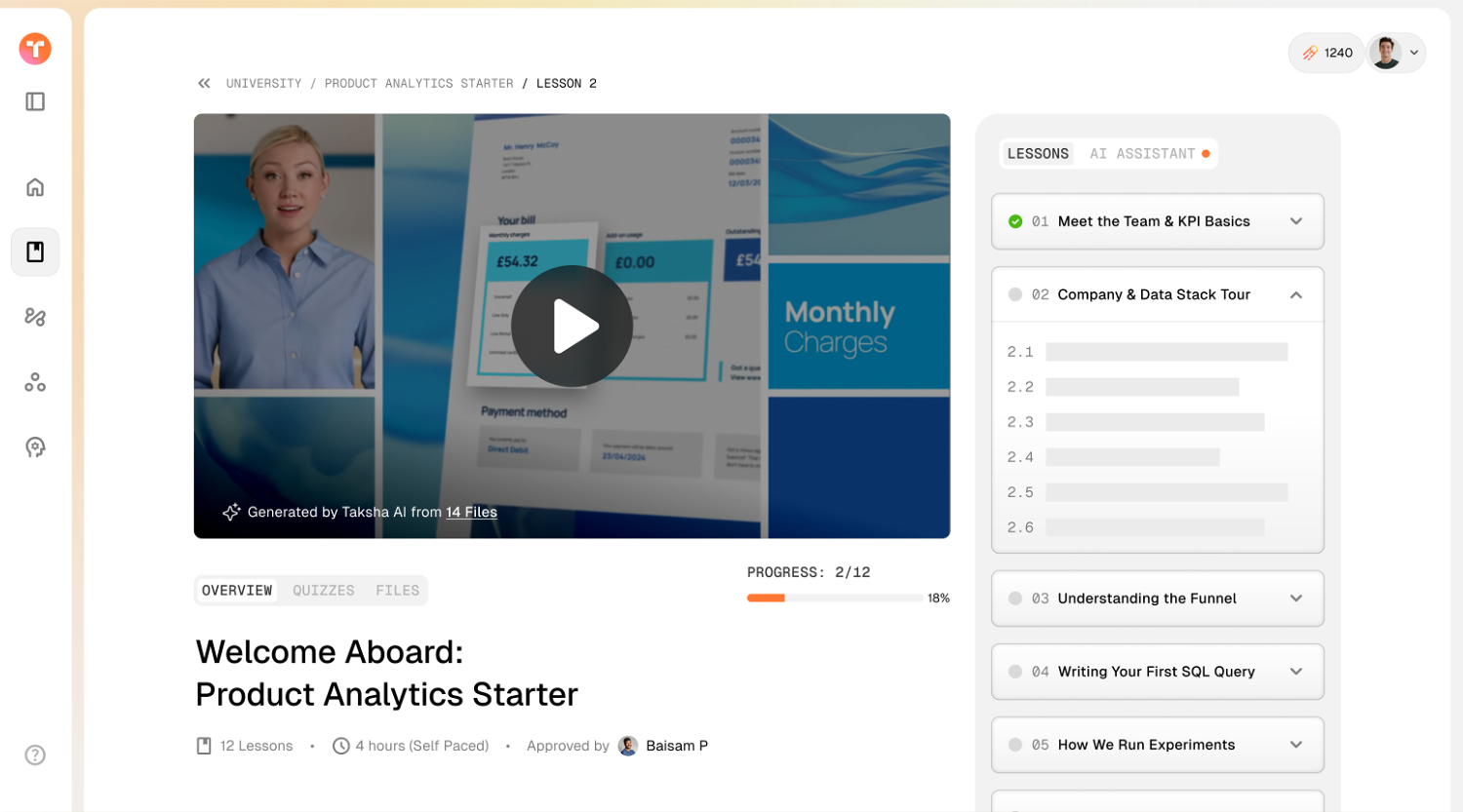
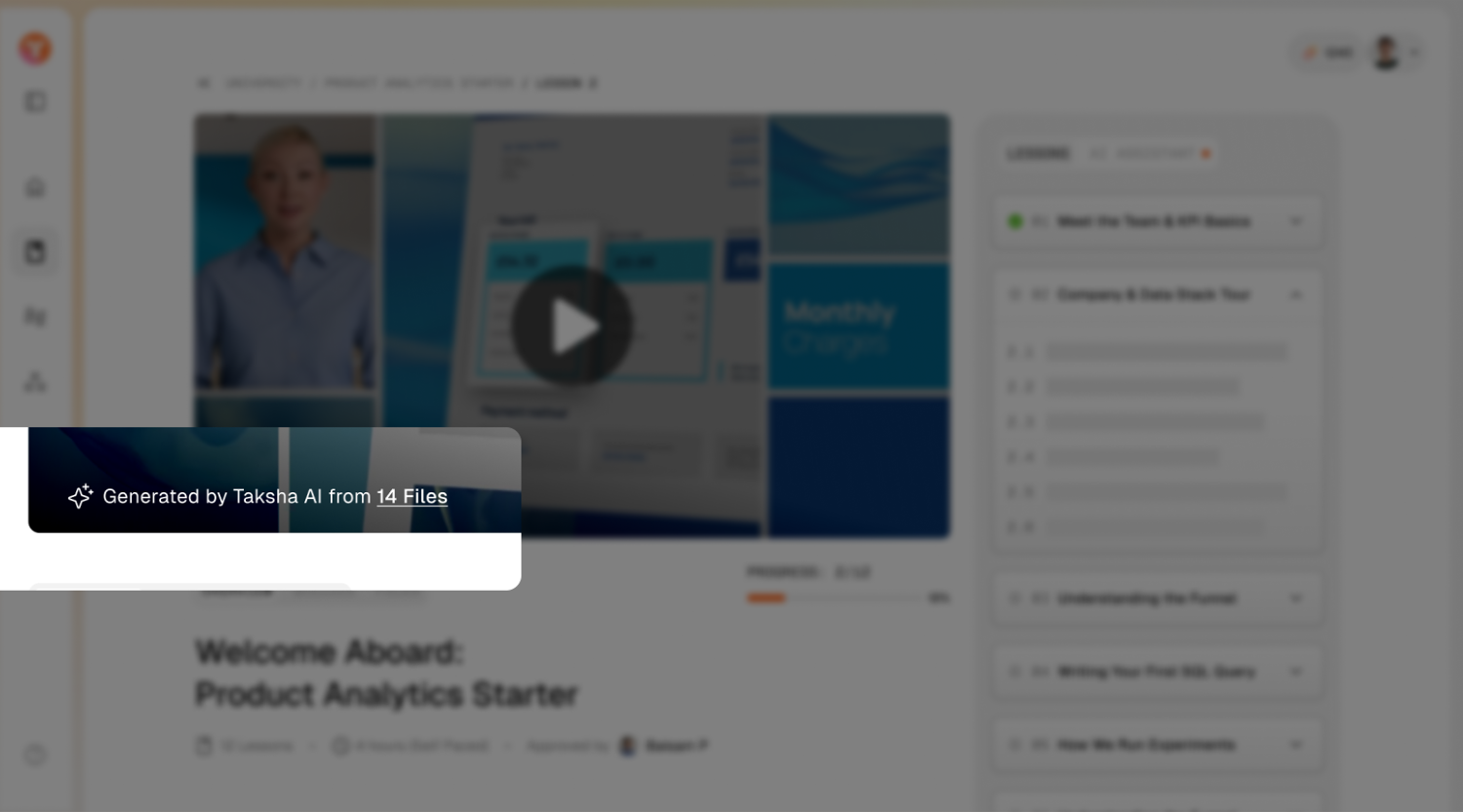
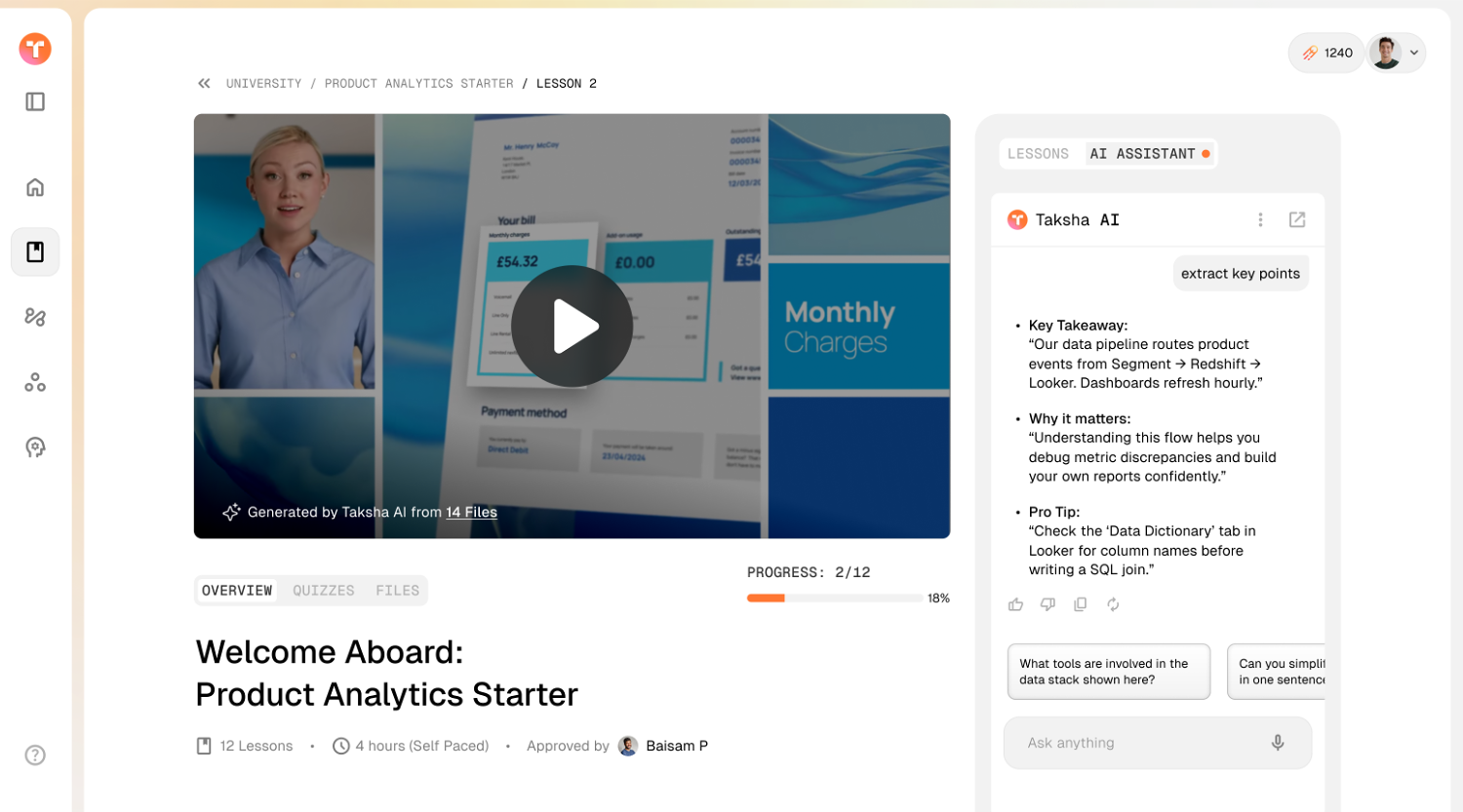
No receipts, no render. Every generated artefact has to name its sources, and “from 14 files” is a link, not a reassurance. Testers stopped reading AI output as a rumour the moment they could click it.
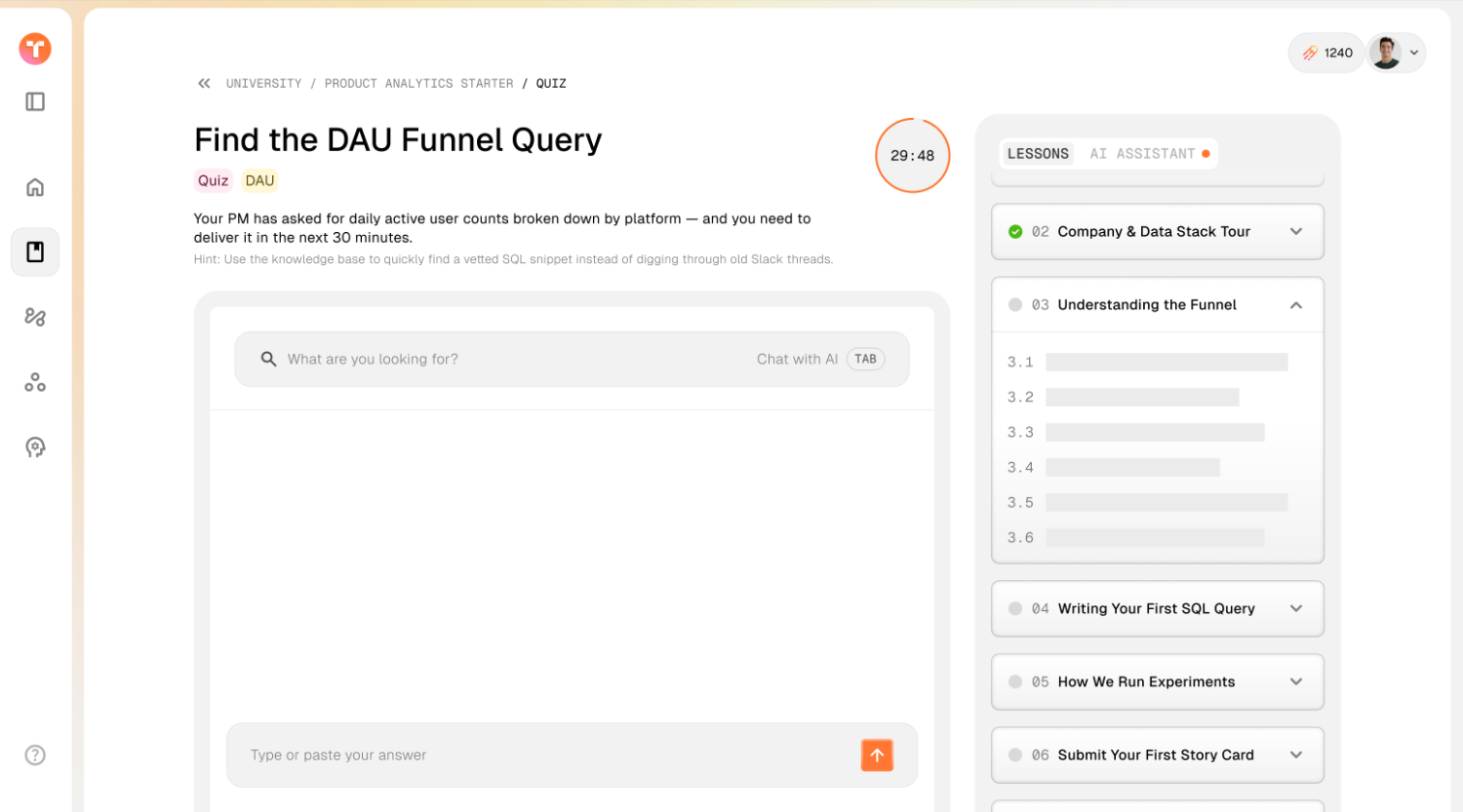
Instead of a quiz about the tool, Aditya gets a real errand with a 30-minute timer:
“Your PM needs daily active users by platform, in 30 minutes.” Exactly the panic he'll face for real in week two.
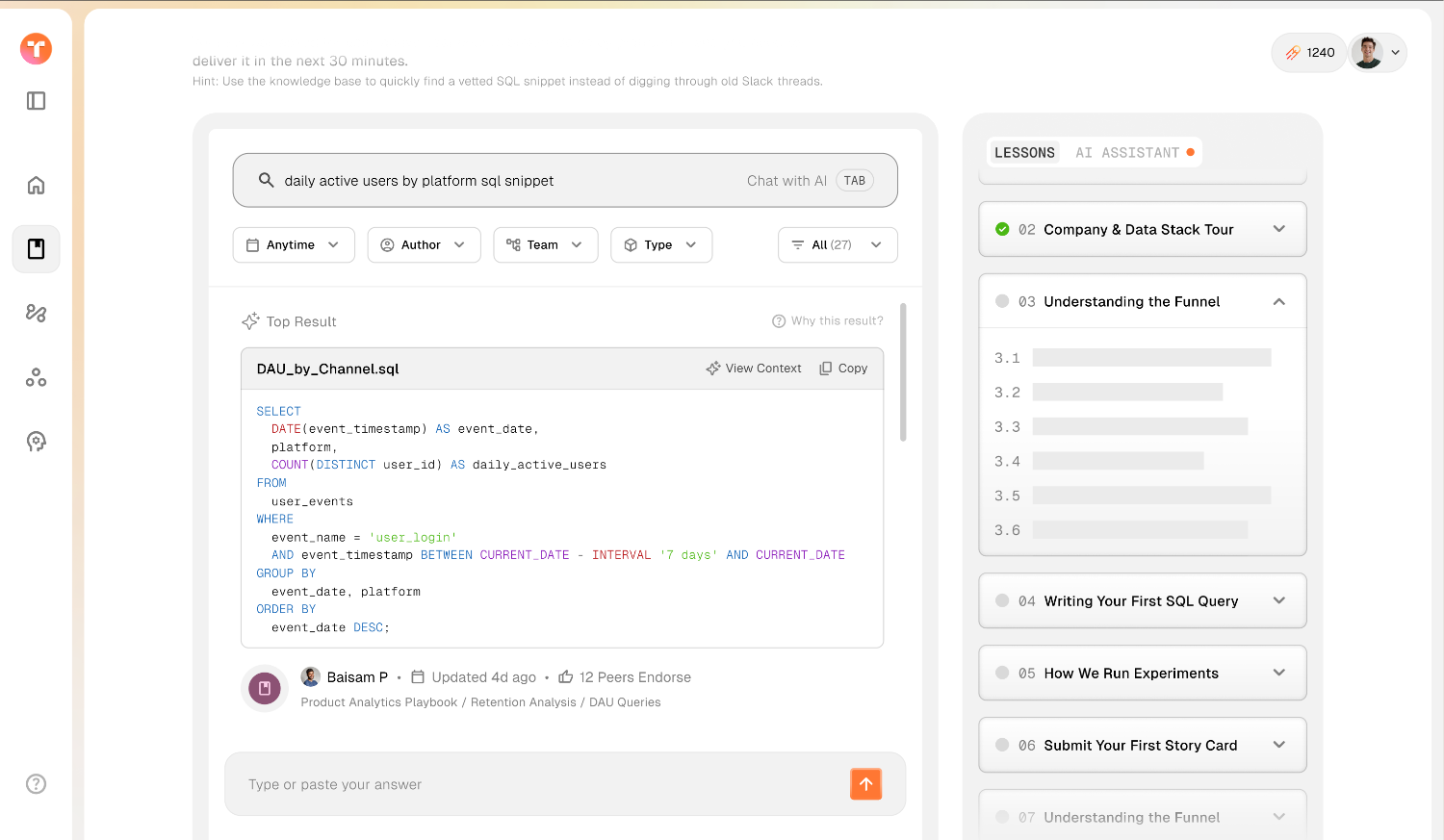
Smart Search surfaces the team's vetted SQL snippet, endorsed by 12 peers, instead of twenty minutes of Slack archaeology.
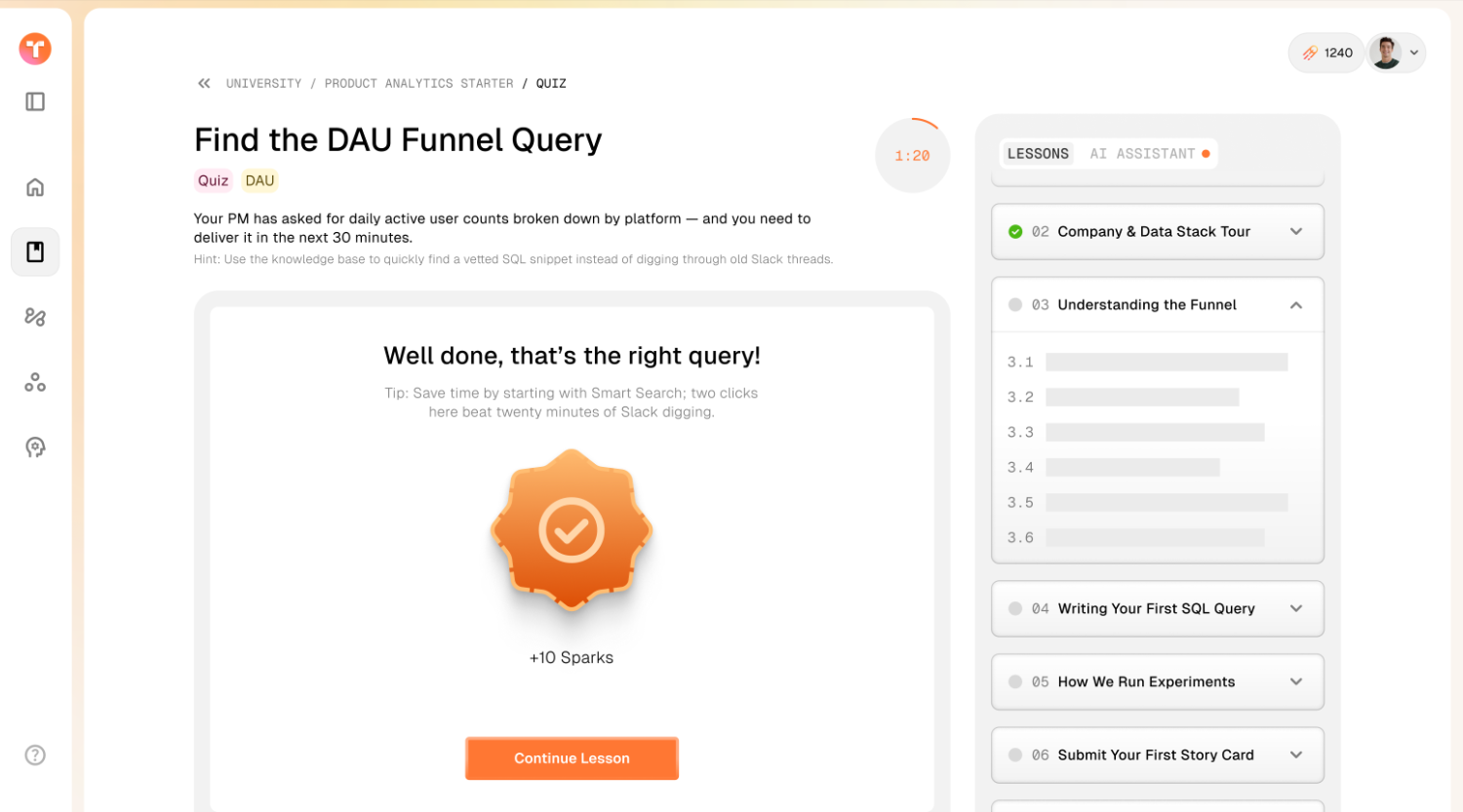
Right query, +10 Sparks, and the habit that matters: search the memory first, interrupt a human second.
Past week one, the same engine becomes a university built from the company's own memory.
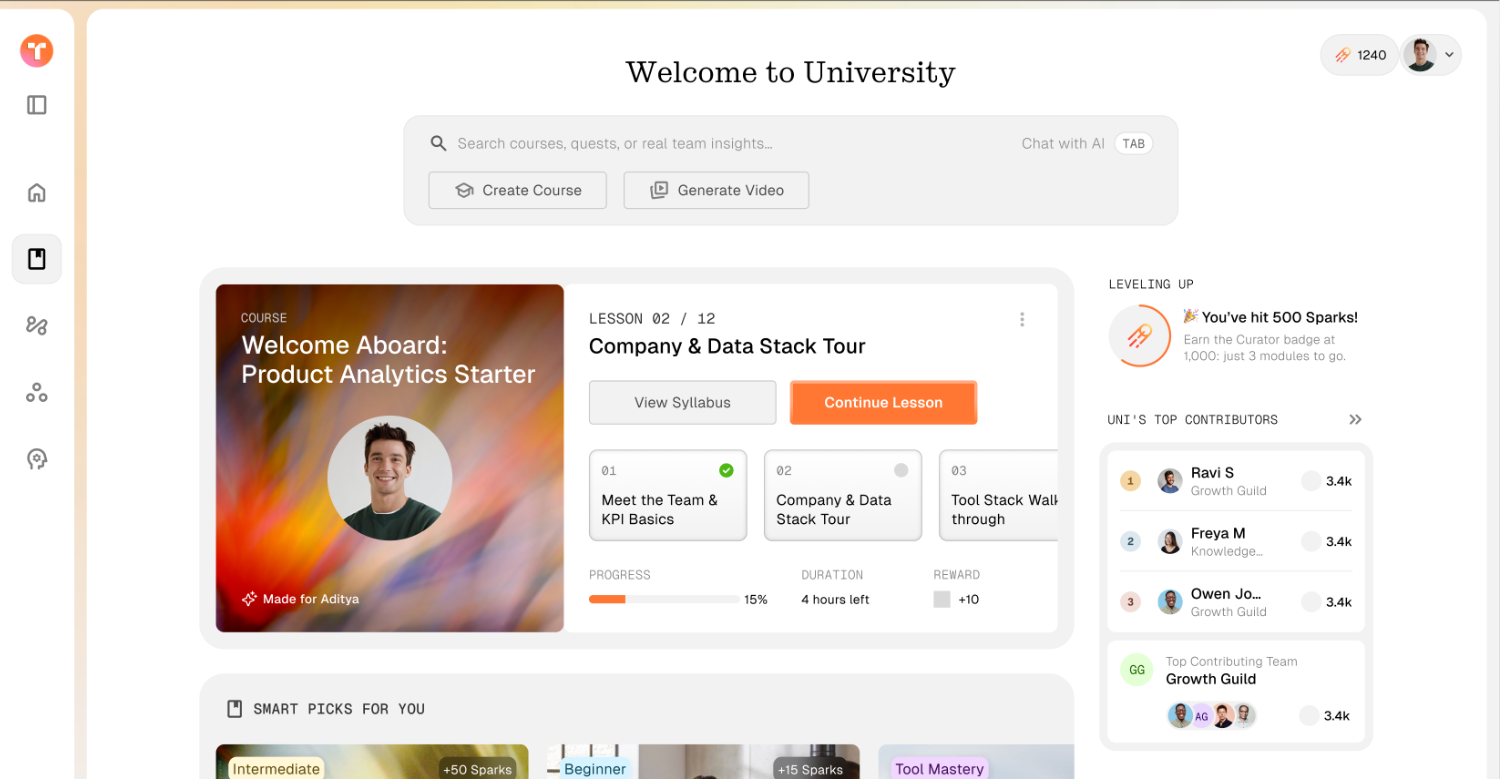
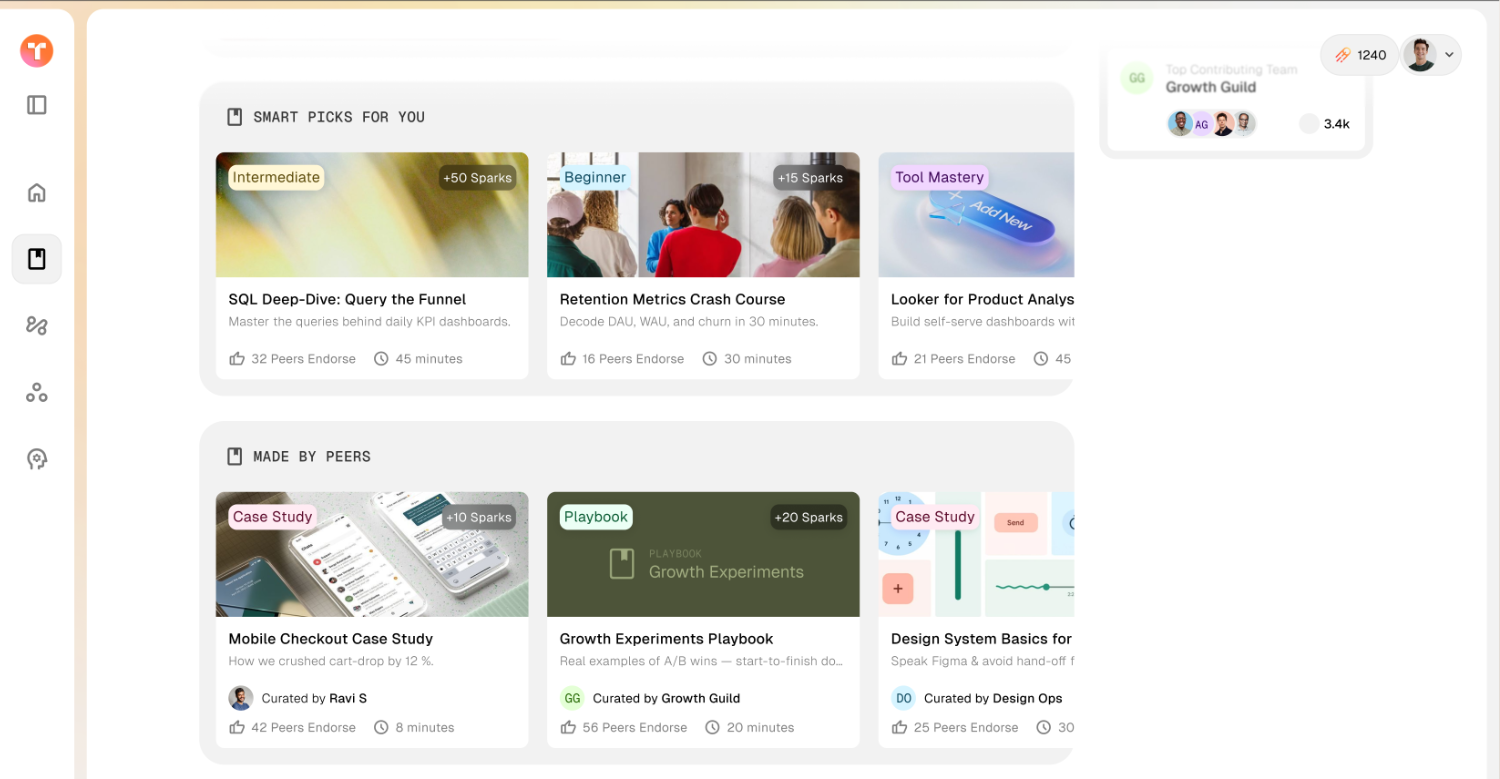
Same engine, three jobs: ramping up new joinees, moving people between squads without the three-week context beg, and turning exit interviews into capture instead of goodbyes.
smart search, everywhere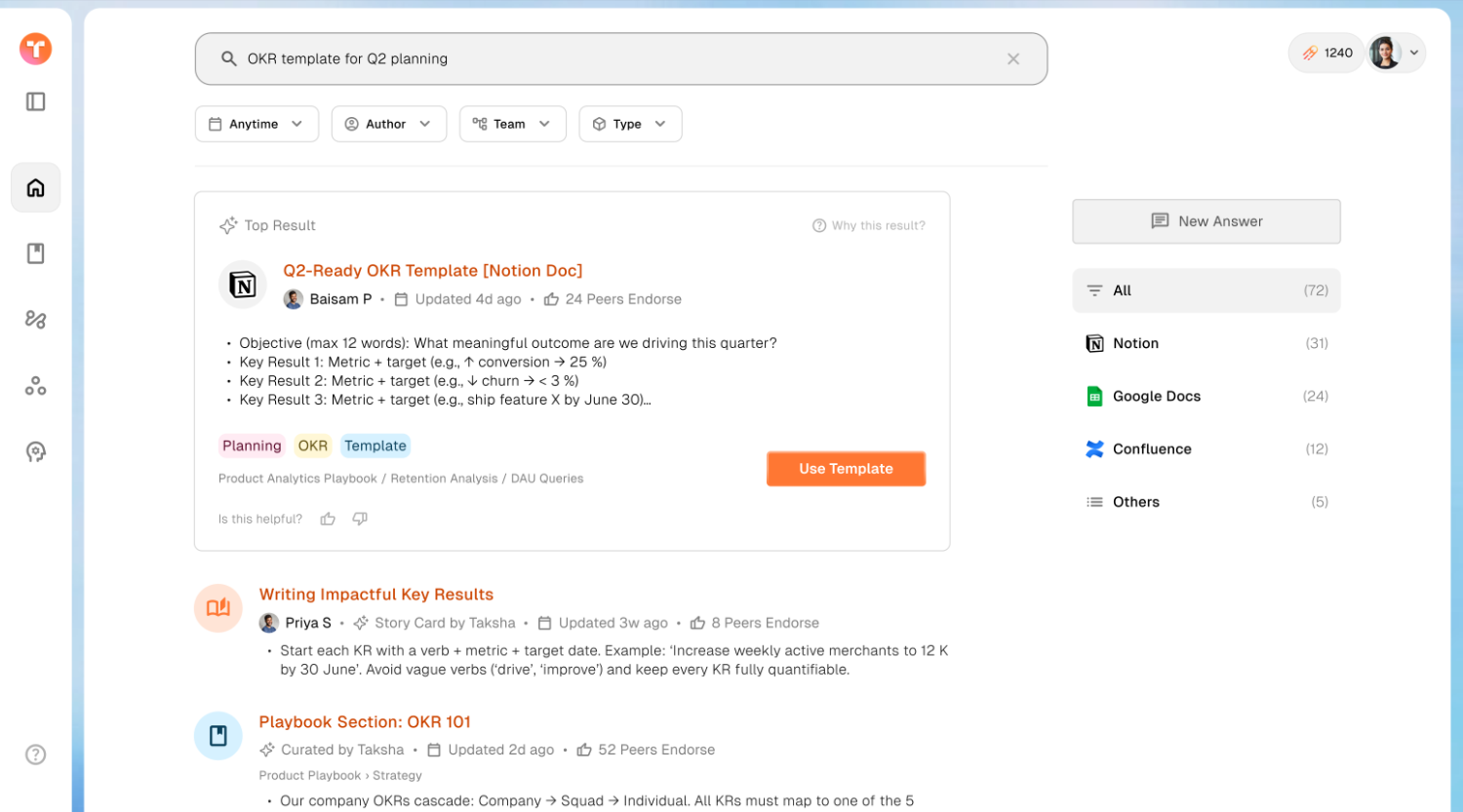
Back from two weeks of leave, coffee still brewing, and this lands in his inbox:
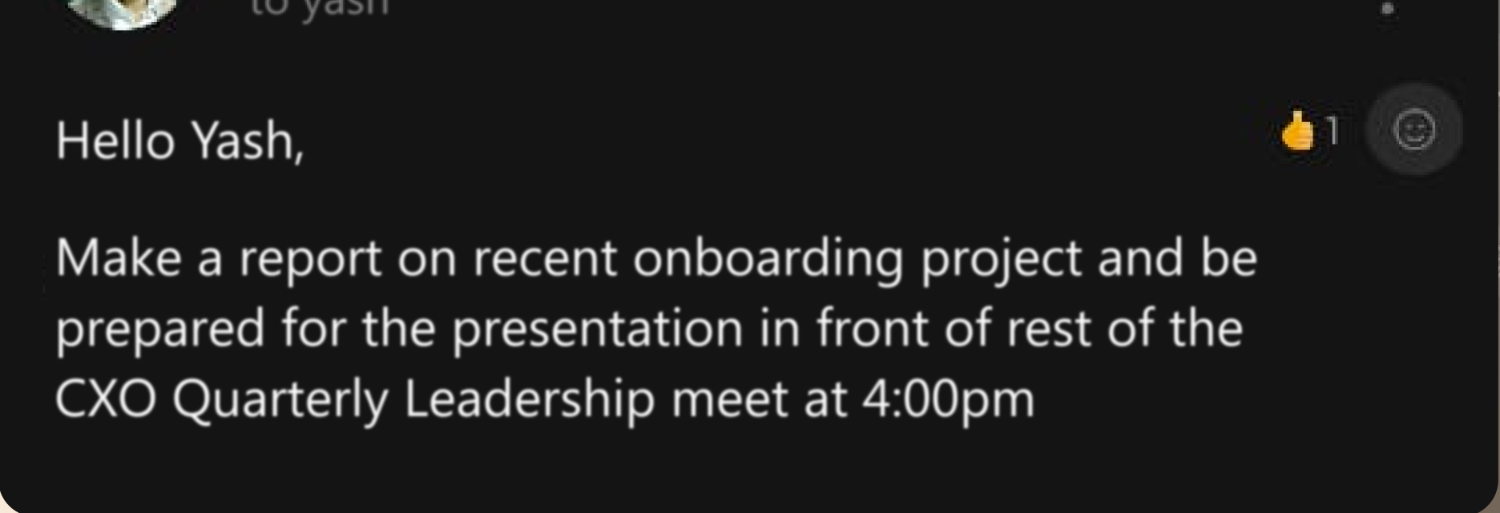 a report. on a project he missed. by 4pm.
The old version of this: two hours of Slack scrollback, three “quick calls”, a deck assembled from fear. The Taksha version is a walk through the project's memory:
pillar: recording · playbooks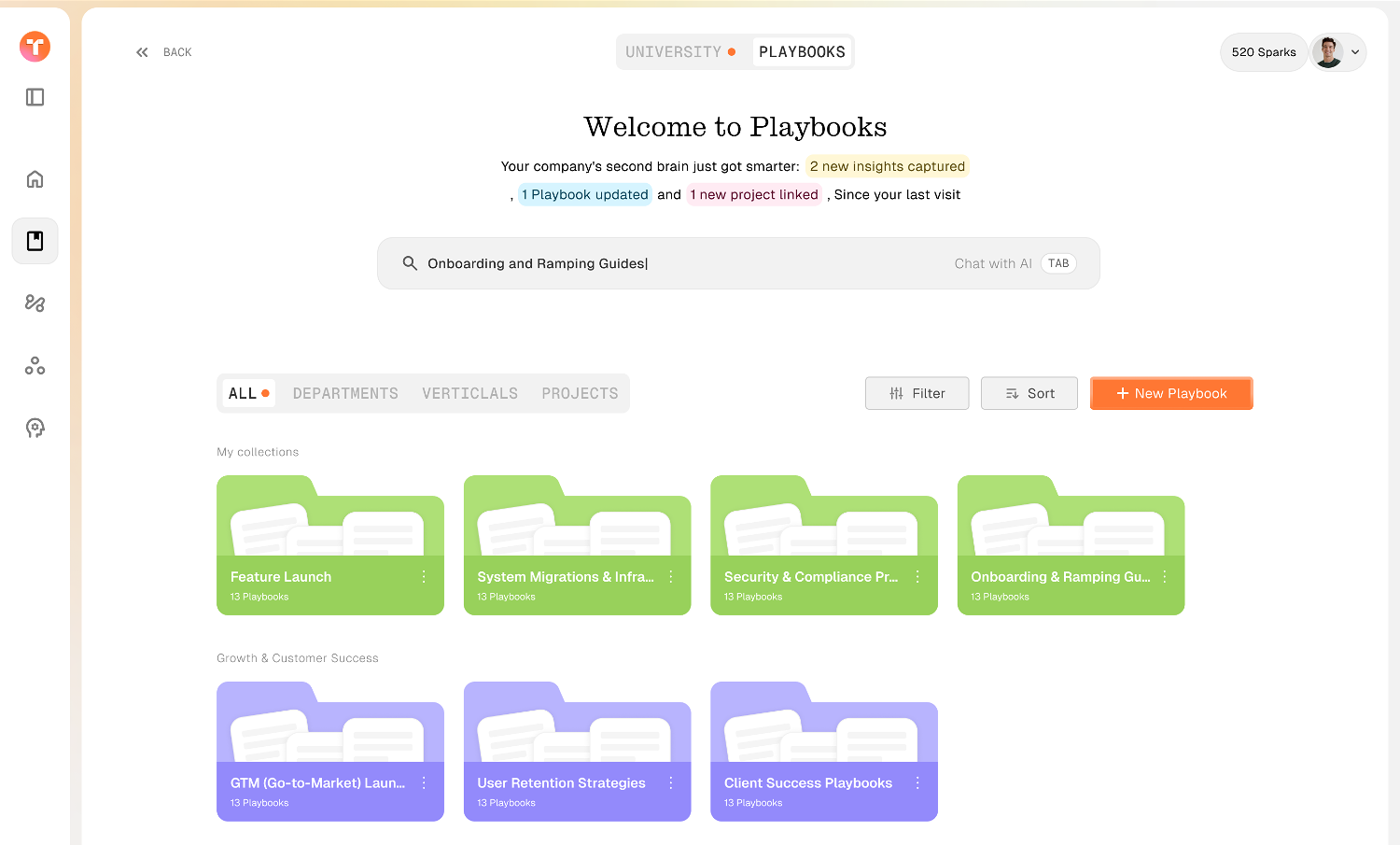
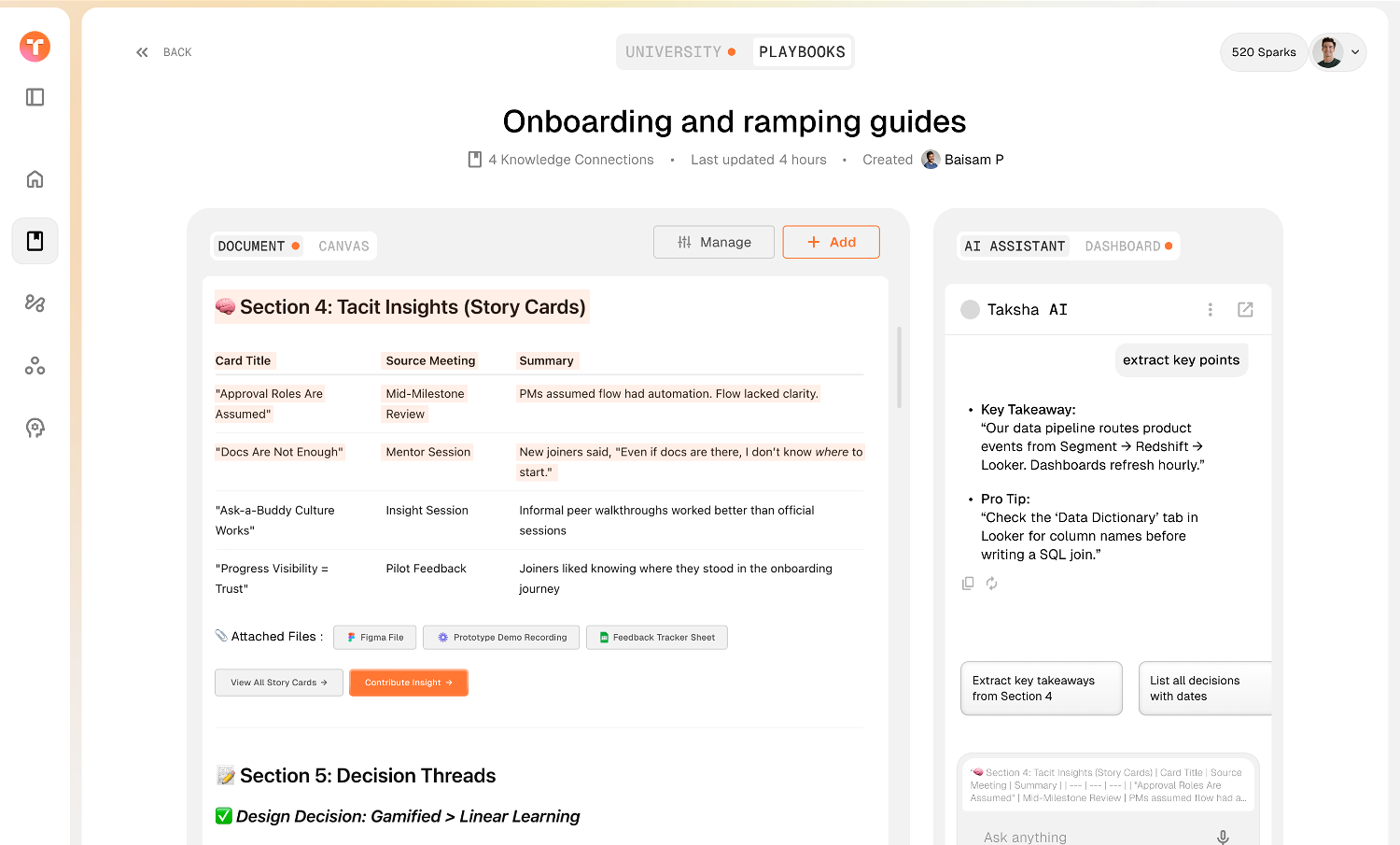
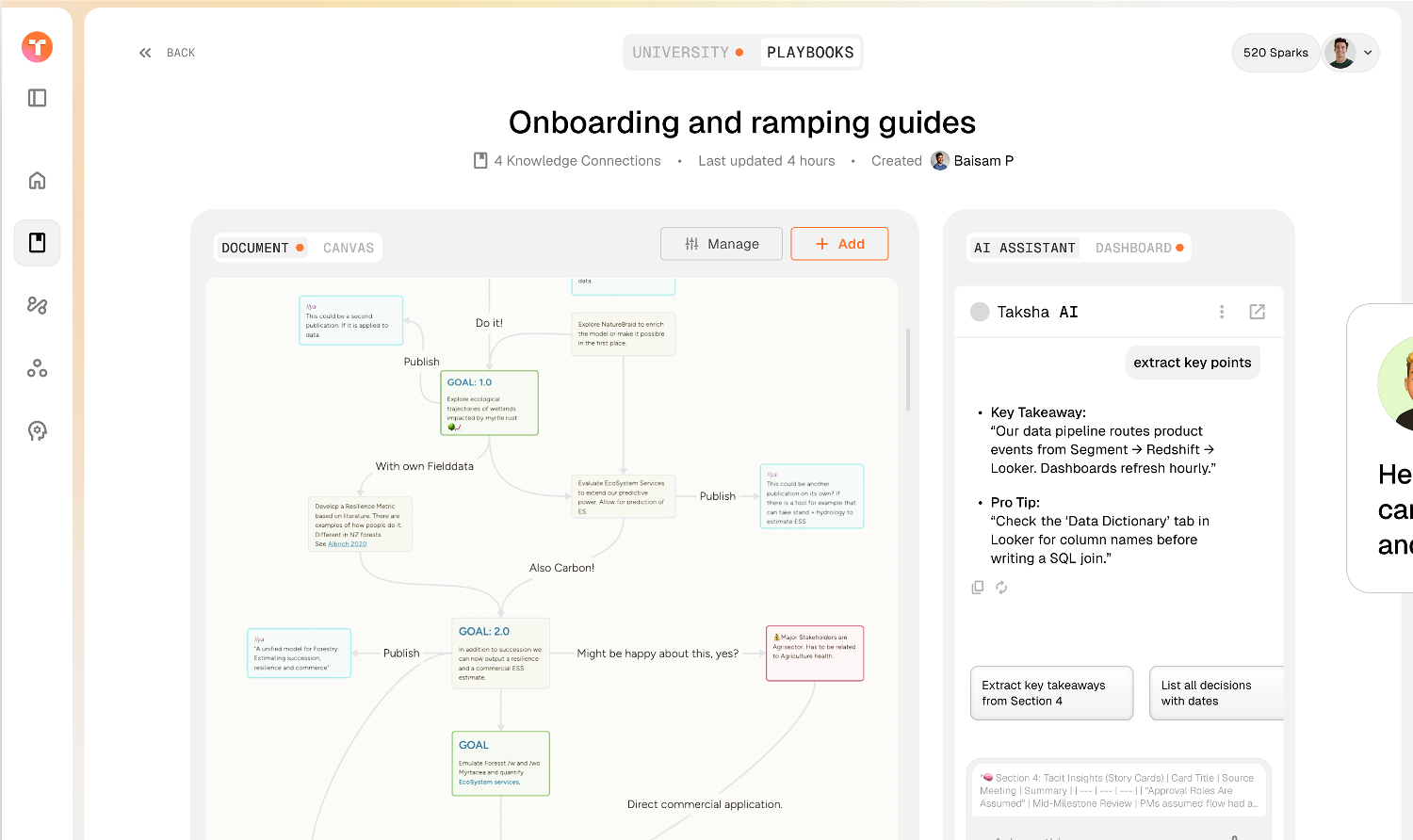
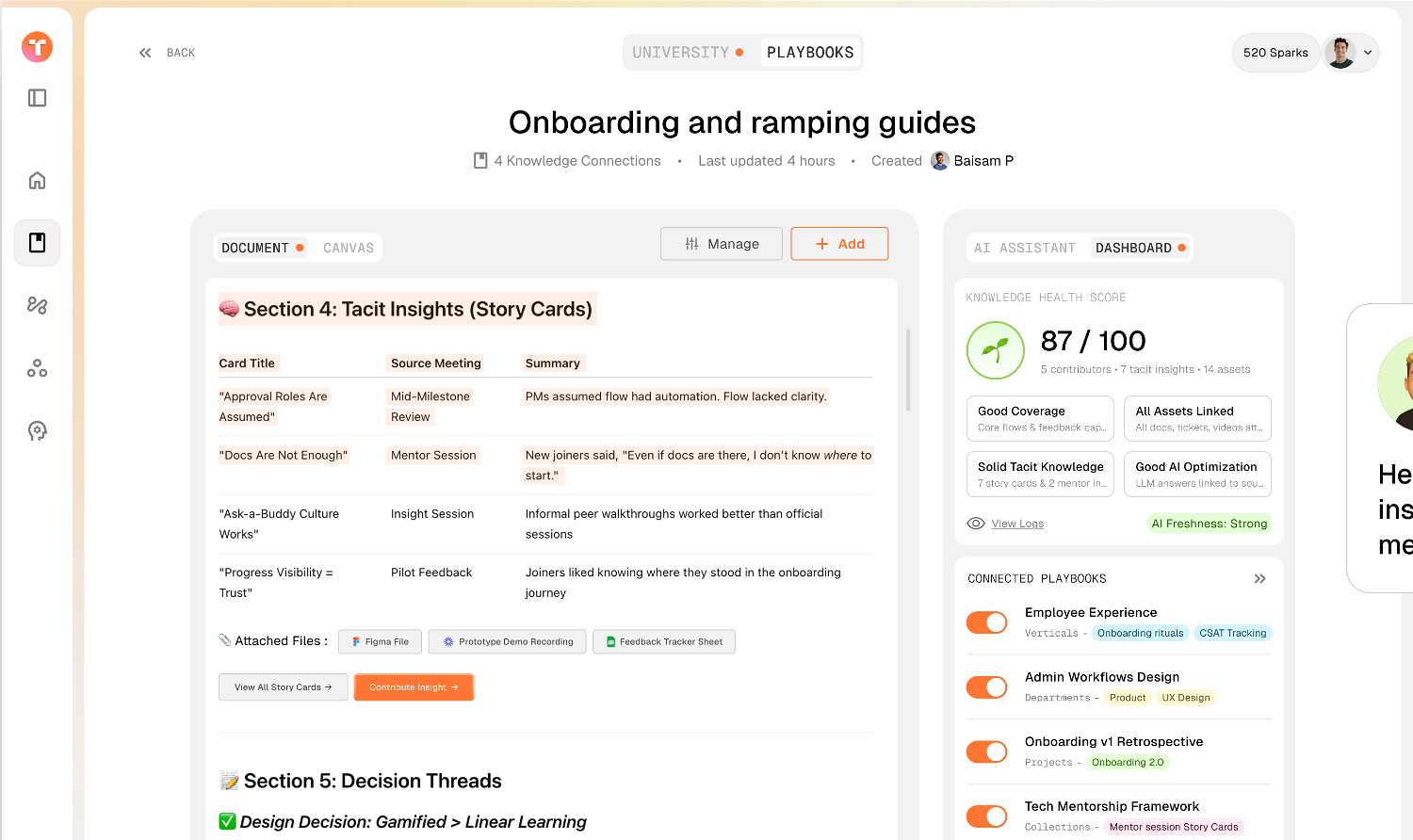
Capture happens where knowledge is born, mid-meeting, not in a doc nobody writes.
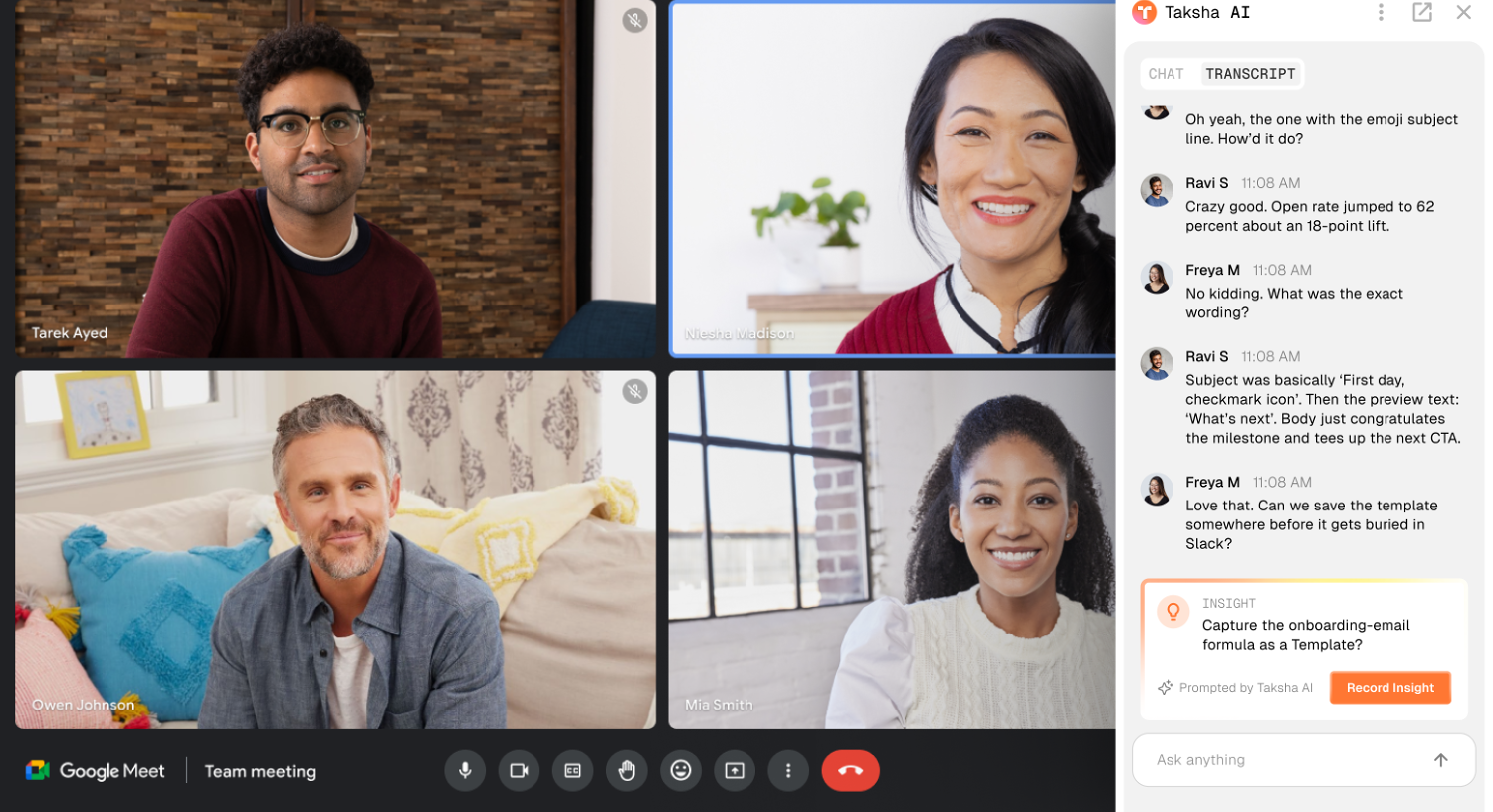
Viva Topics scraped quietly and died quietly. So capture asks for one human yes, and it asks in the second someone is already thinking “can we save that somewhere?”
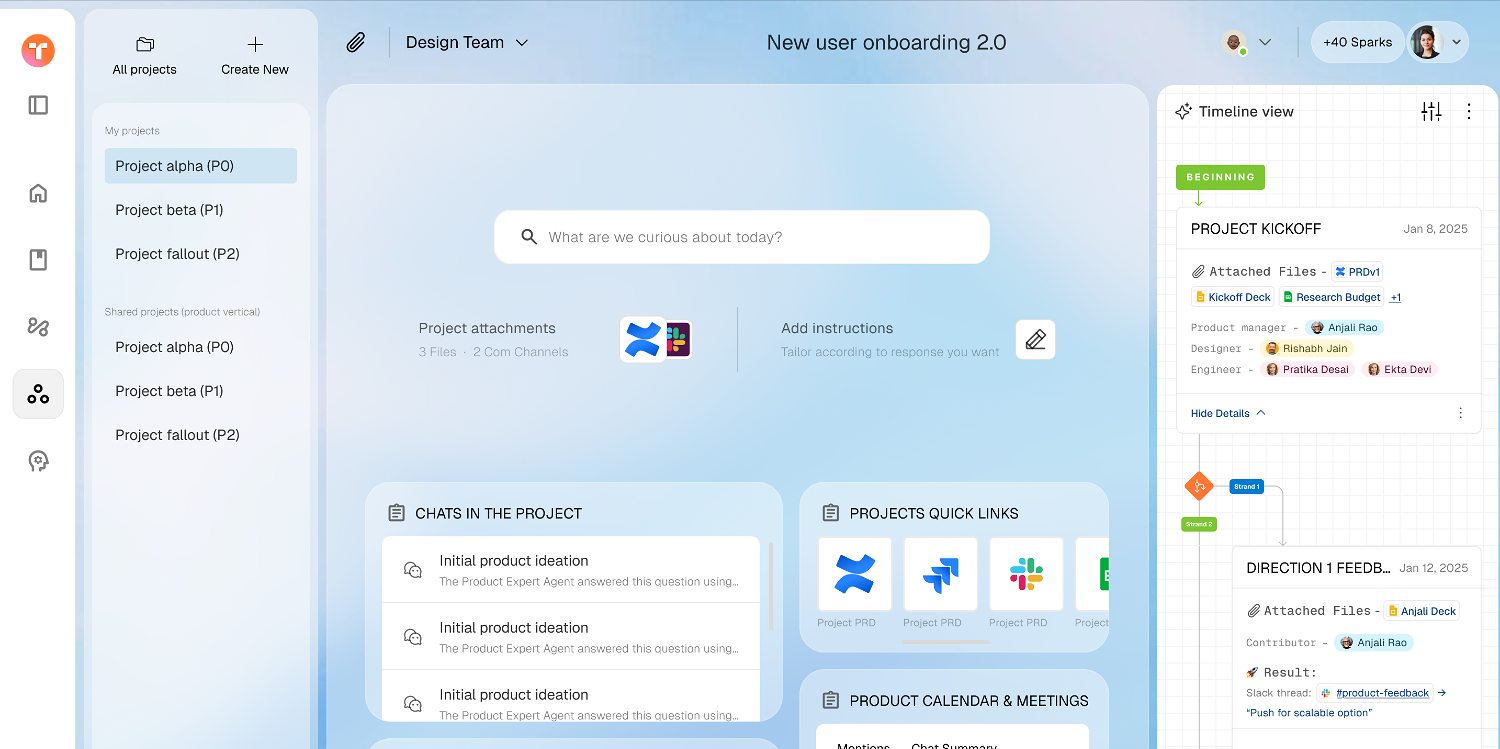
Every project keeps a queryable spine of what happened while he was away:
Chats, quick links, calendar and mentions for “New user onboarding 2.0”. One address for the whole effort.
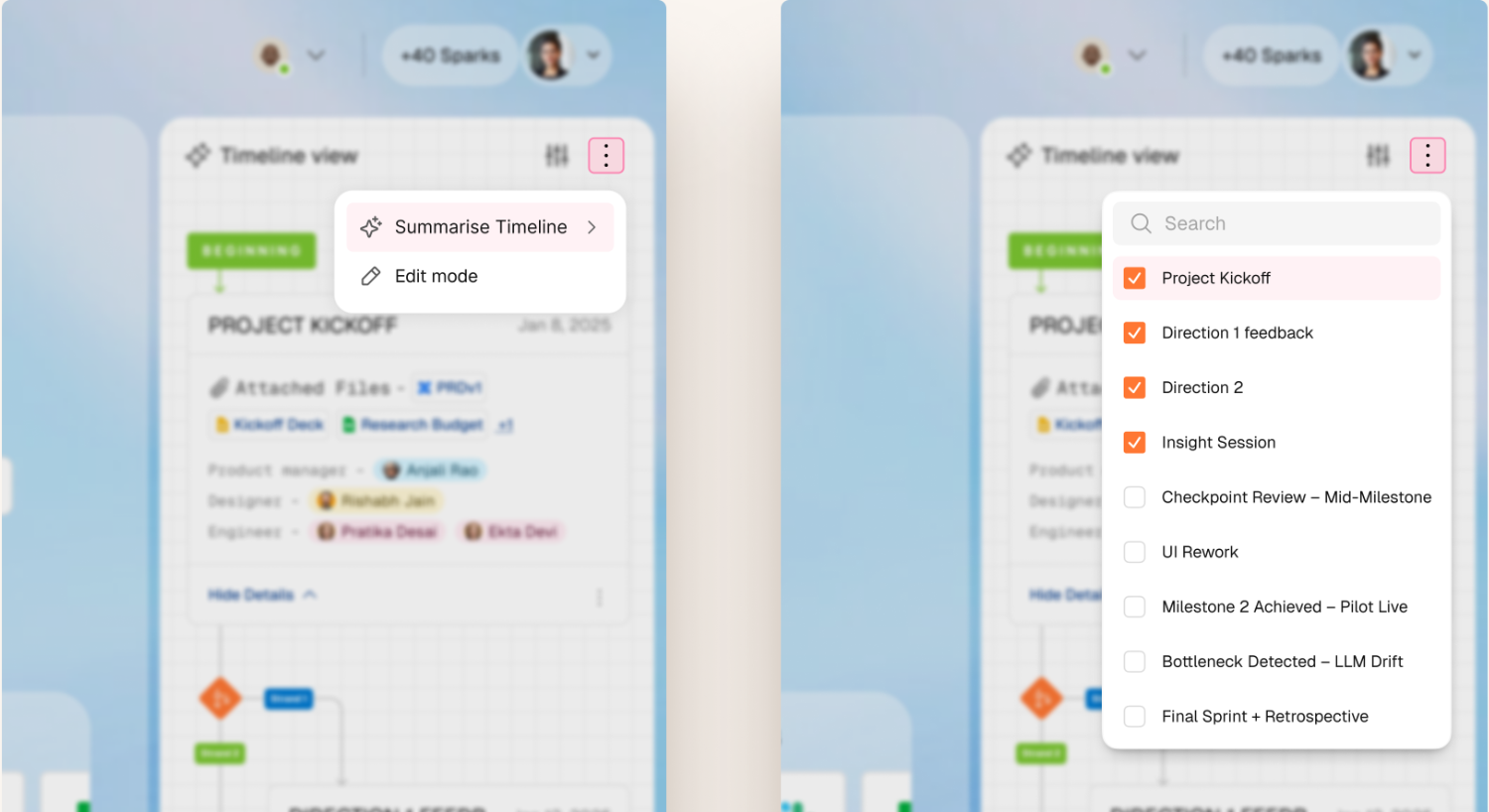
Kickoff → feedback → direction change, as nodes with attached files, owners and Slack threads.
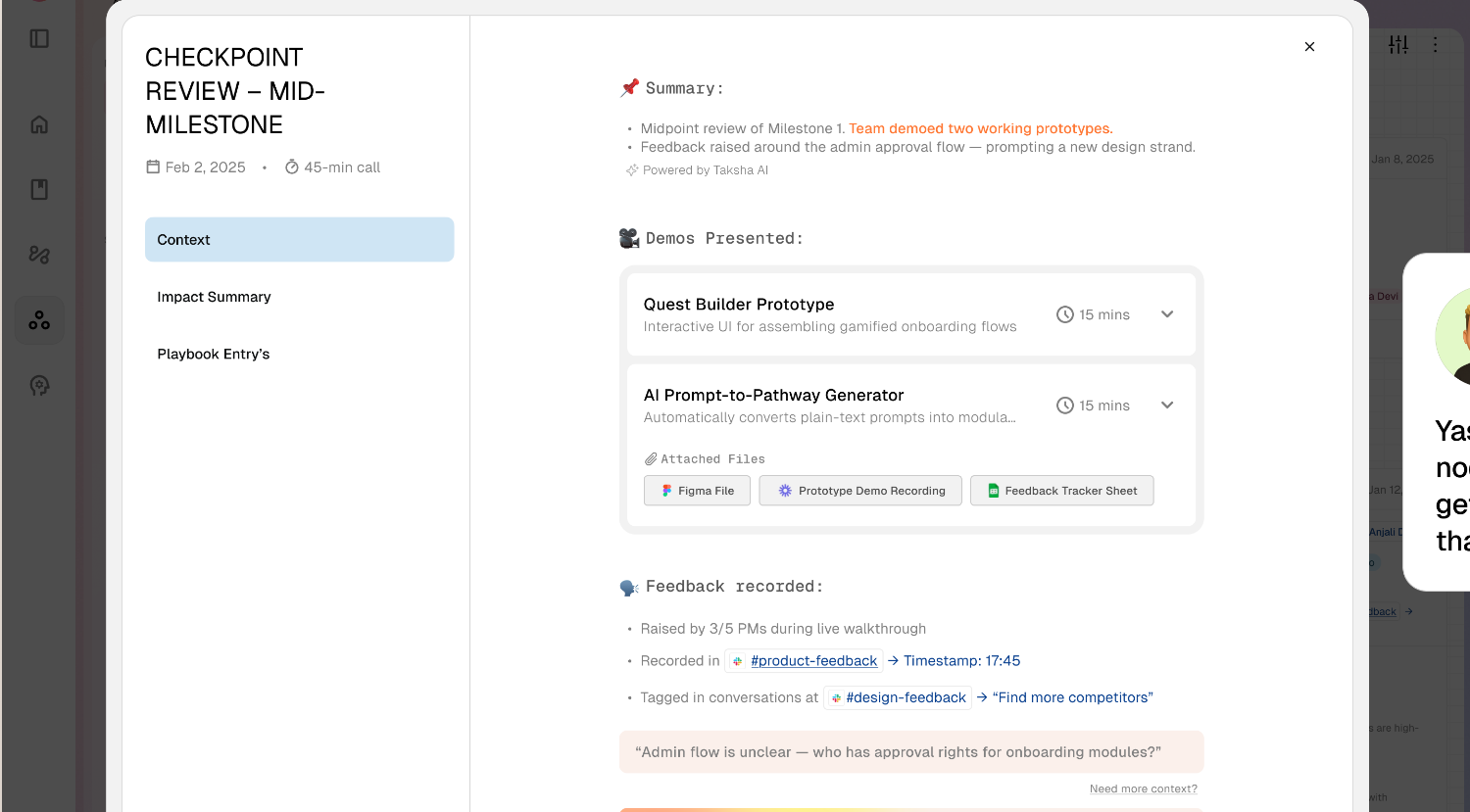
The mid-milestone review: demos shown, feedback recorded, and the exact quote that changed direction, timestamped.
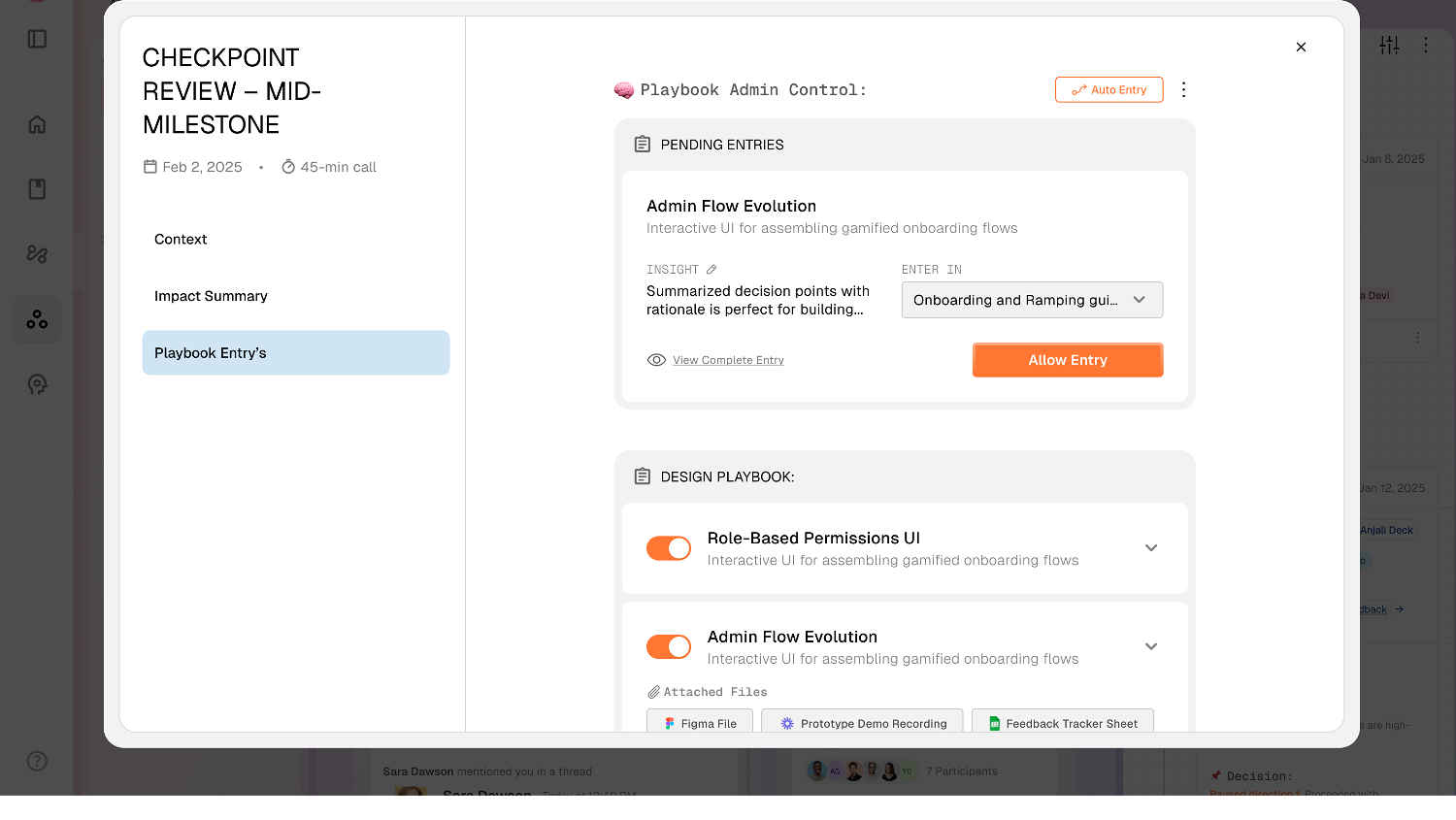
Pending playbook entries wait for a human yes. The memory stays curated, not scraped.
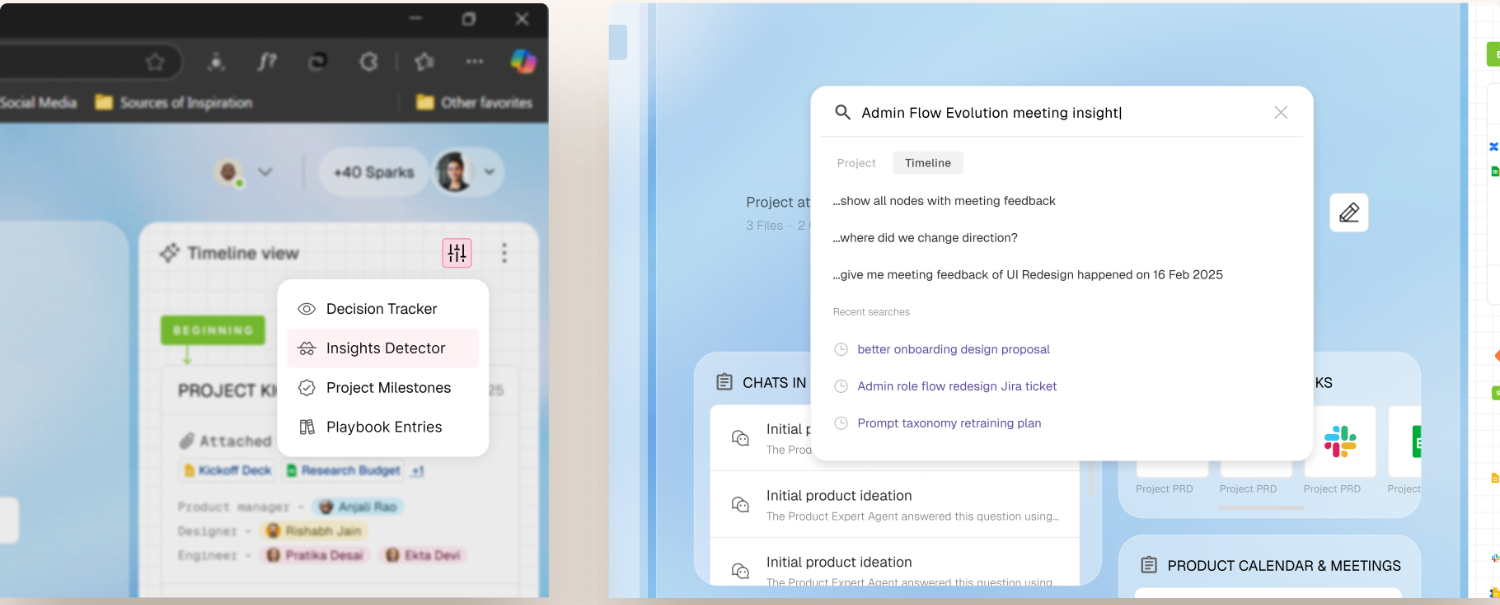
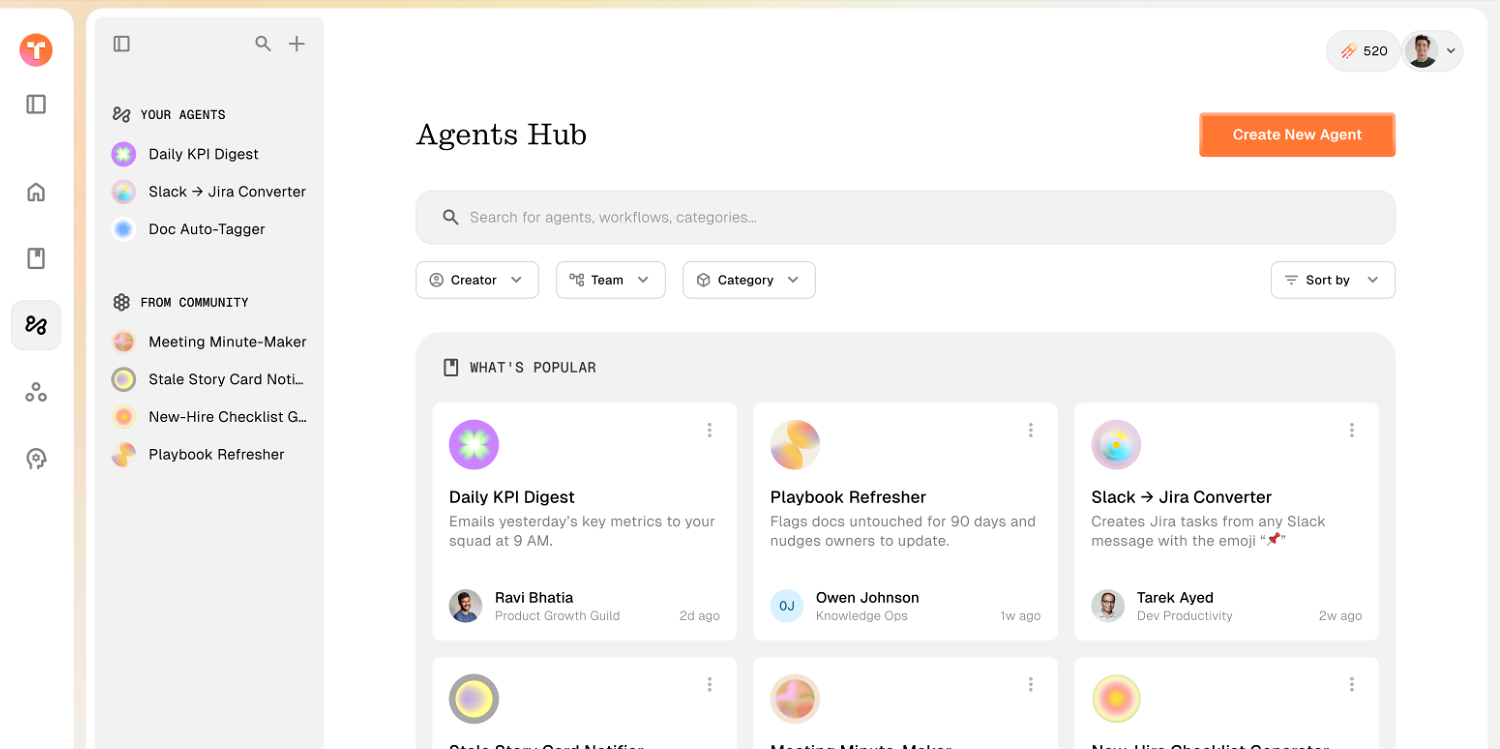
Then the memory starts working for you: agents that turn retrieved knowledge into finished chores.
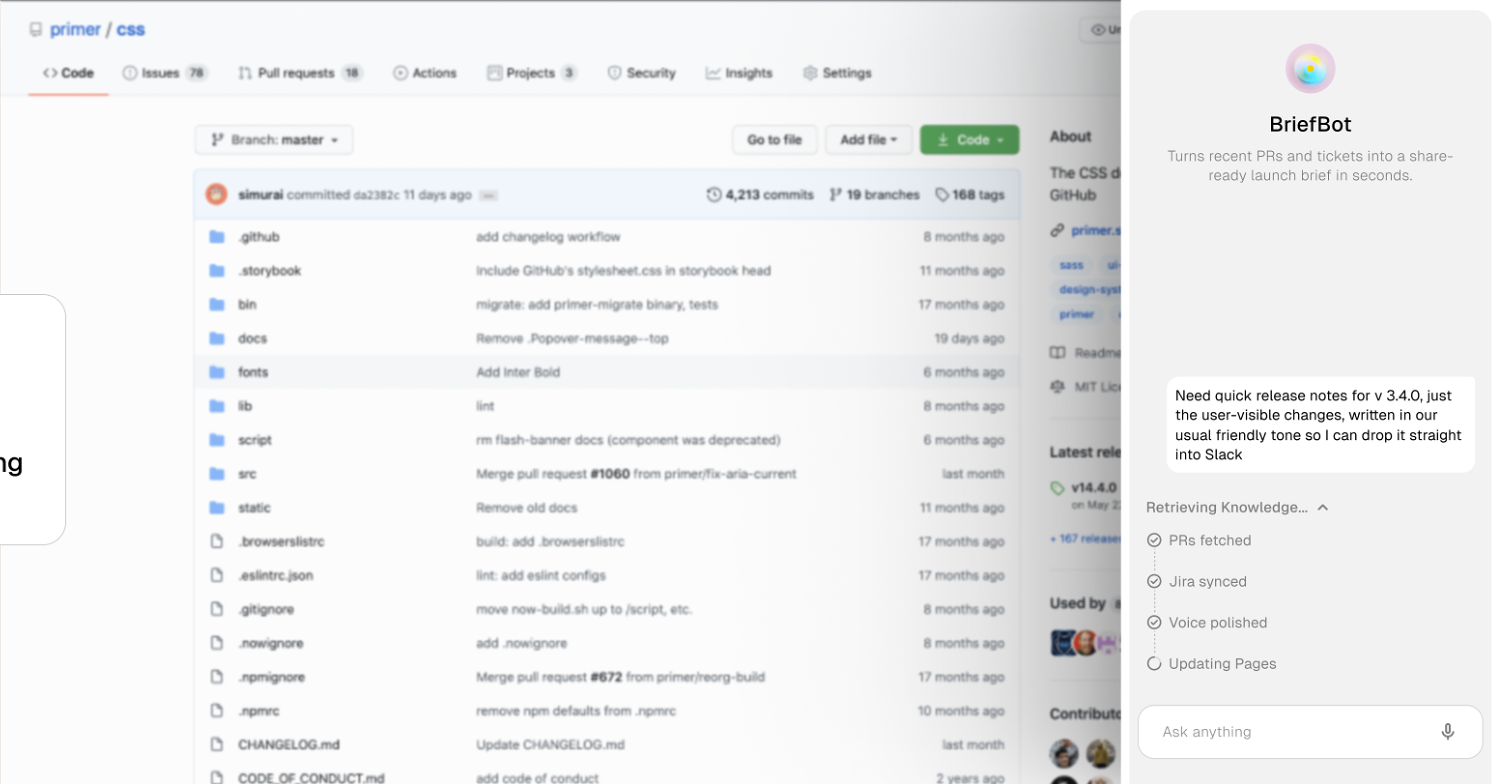
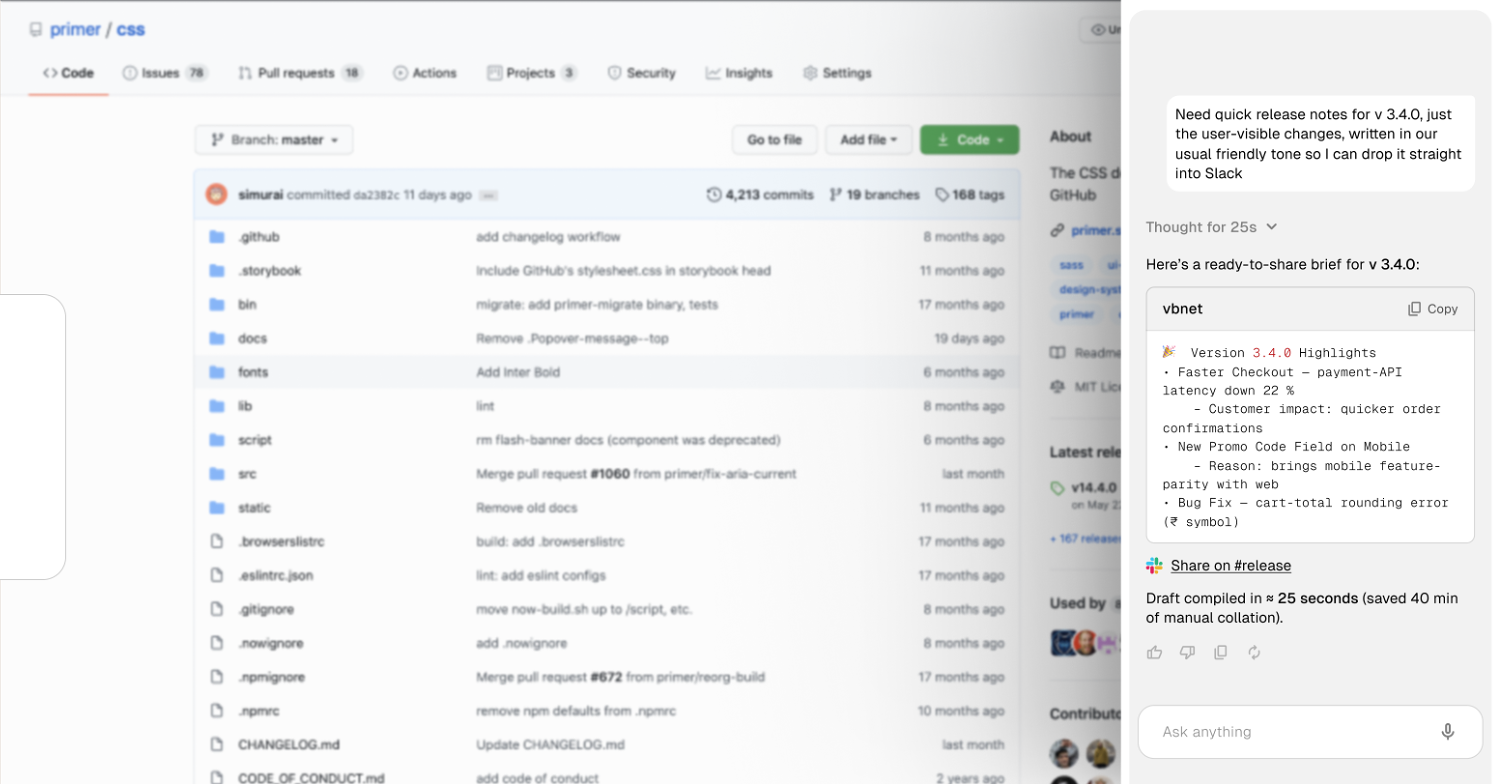
His 4pm report? BriefBot reads the PRs, the Jira tickets and the team's tone of voice, and returns a Slack-ready brief. Draft compiled in ≈ 25 seconds; the manual version took him 40 minutes last quarter.
If sharing doesn't pay in something visible, the 47% who hoard keep hoarding, rationally. So: a Spark for the act, a constellation for the pattern, a galaxy for the quarter.
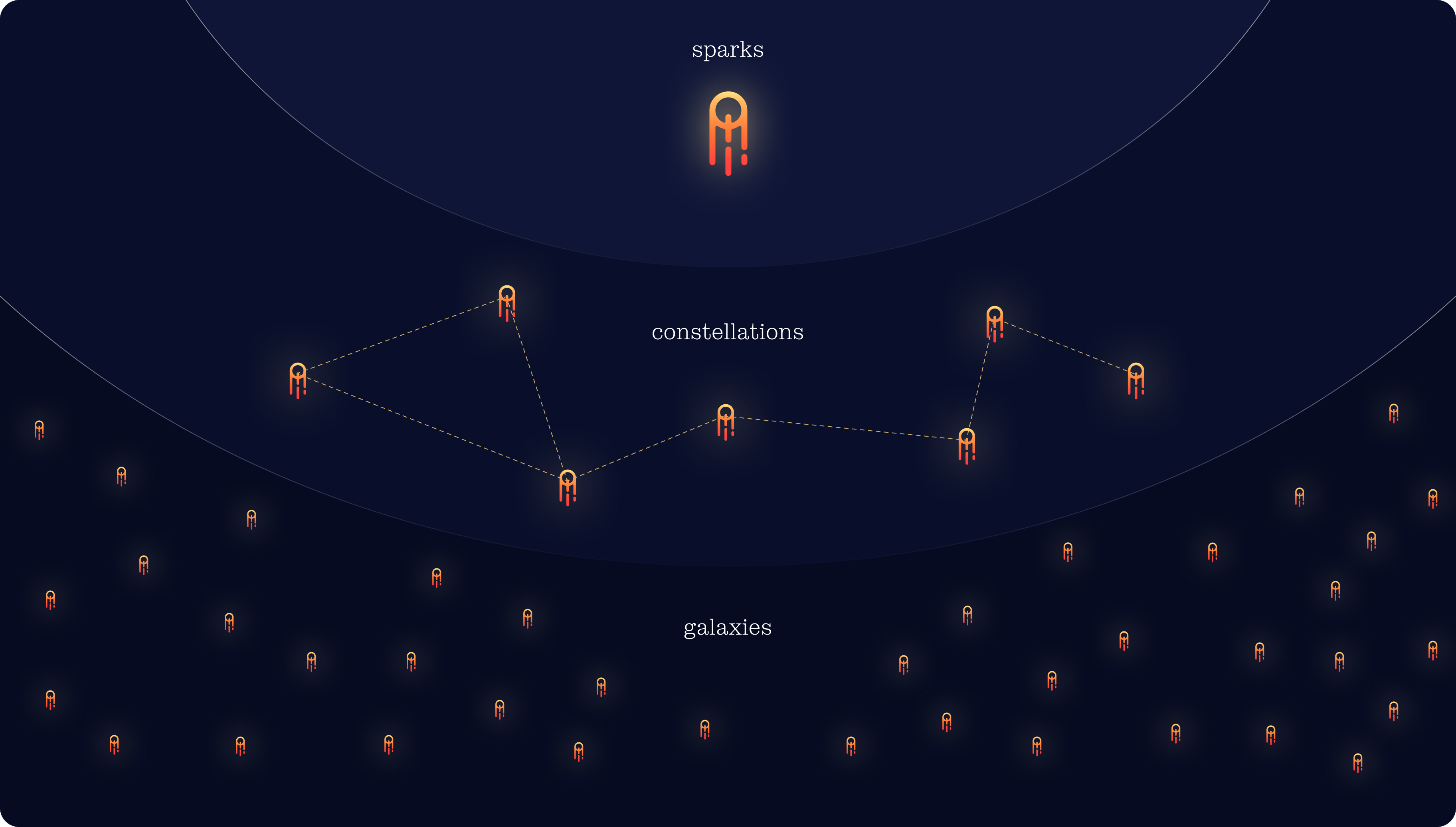
Every captured insight, endorsed answer or finished quest mints a Spark, one unit of “I made the memory richer.”
1 act · 1 sparkEndorsed sparks link into constellations: visible patterns of what a team actually knows.
many sparks · 1 patternOver quarters, constellations settle into galaxies, a searchable sky of company memory.
a quarter · 1 sky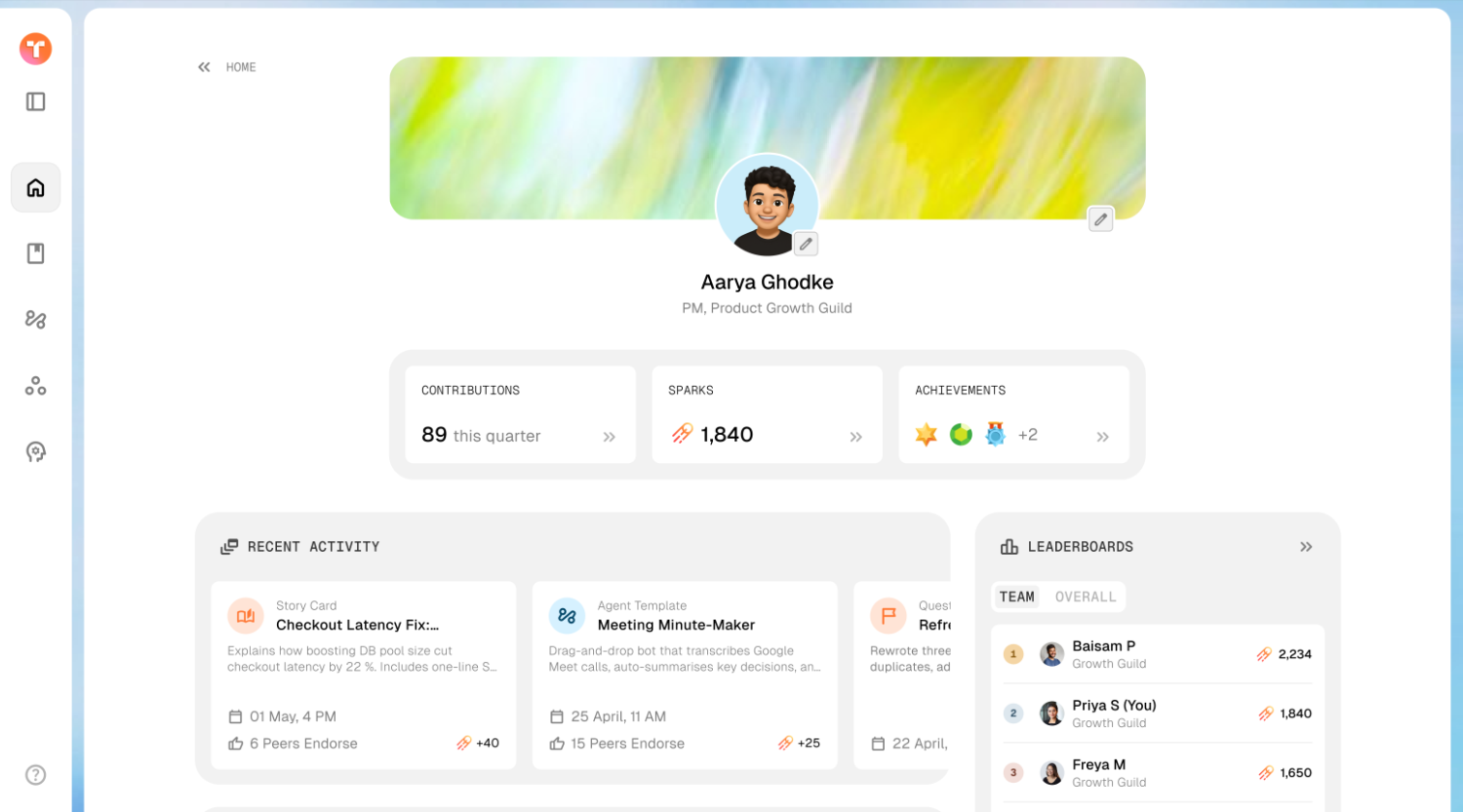
Sparks reward usefulness, scored by peer endorsement, never volume. Pay for volume and you've designed a spam machine with badges.
All of it came together as a role-played prototype, Aditya's week and the senior's Tuesday, demoed end to end.
Taksha is a thesis, not a shipped product, so the honest scoreboard is what it proved, what it taught, and what we'd bet on next.
The capture-to-incentive loop landed as the strongest idea in the final jury.
Prof. Kalita backed the direction at every review; his consistent push was rigor, trace every screen to a finding. The jury's read matched our research bet: retrieval is everywhere, supply is the open problem.The four-pillar diagram did more editing than any critique. When a screen couldn't name its pillar, it died, and the product got sharper each time.
Trust in AI output is a design problem, not a model problem. “Generated from 14 files”, clickable, changed how testers treated every answer.
The sparks economy needed balancing like a game: reward usefulness, not volume, or you've designed a spam machine with badges.
Demoing through Aditya and the senior forced every feature to earn a place in someone's day. It's how this case study is written, too.
Glean, Guru and Notion fight over retrieval. Capture + motivation is an open category, and the moat compounds, because memory does.
“Cut ramp-up from 3 months to 3 weeks” is a number a CFO can love. Land there, expand into the full memory.
Beyond the thesis: pilot with one real team and watch three numbers, time to a new joiner's first contribution, the endorsement rate on captured sparks, and whether the senior's interruption load drops. If those move, the rest follows.
Workstreams turned into branded, publishable stories.
Monetizing reusable agents and playbooks across orgs.
Hands-free capture and retrieval, in the hallway where knowledge actually moves.
A two-person bachelor thesis, built with Aarya Ghodke.
Equal partners on every pillar, so this telling walks my half of it. Guided by Prof. Dr. Pratul C. Kalita, and named for a university that kept knowledge alive for a thousand years, which felt like the right bar for a company's memory.